Chestnut Trees on the Thames

Friday, 31 March 2017

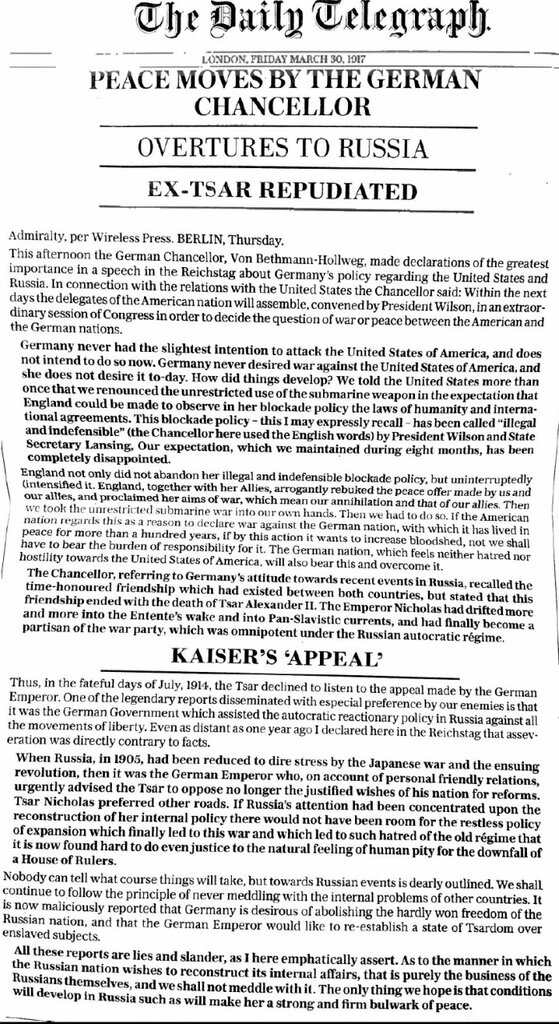
100 Years Ago - Russia, Poland, Ukraine


russia-7.jpg
http://www.thetimes.co.uk/edition/register/rail-travel-restrictions-at-easter-f97kflkqm


March 31, 1917

Rail travel restrictions at Easter

It is desirable that the public should understand the reasons which have prompted the Board of Trade to appeal for a general abstention from unnecessary railway travelling during the Easter holidays. The warnings issued have nothing to do with the necessity for economy in personal expenditure, though the need for saving remains imperative enough. They are not the outcome of a desire to discourage the holiday-making spirit, though this is no time for relaxation, when the culminating crisis of the war may be at hand. The reason is more simple. Our railways have been so depleted, both of men and rolling-stock, that they cannot carry holidaymakers, and those who have the opportunity of a few days’ rest must therefore stay at home.
The Railway Executive Committee has done its best to warn people. Booking-offices will not issue tickets after next Tuesday until after Easter Monday. Even at the stations no tickets will be issued in advance. Through bookings over the lines of more than one company will be suspended. There will be no excursions or holiday trains.
These disabilities are severe but the public will do well to accept the situation without demur. The railway companies cannot help themselves, for every week the demands of the war continue to expand. Ever since the war began men have been going from the railways to the Army, until the deficiency of railway labour is almost as marked as in agriculture. During the last few weeks very large additional numbers have been called up for military service, and still more will soon be wanted. The requisitions of rolling stock have been equally sweeping, and the number of British locomotives and wagons sent to France continues to grow. Our diminished railway staffs are so heavily worked that they cannot handle holiday traffic in addition.
It should be remembered that, although fares are higher and trains slower and fewer, this country has hitherto enjoyed far better railway facilities than any other belligerent. Our railways have faced the ordeal of war with wonderful success, but they can handle traffic only up to the limit of their men and their rolling stock. The utmost sympathy will be felt for the holiday resorts, which may be deprived of the visitors they expected at Easter, but the claims of the war are paramount.
Posted by Chestnut Trees at 06:08 No comments:
Labels: Англія, війна, газети, газети ПСВ, Польща, революція, Росія, Україна

Thursday, 30 March 2017

100 Years Ago in the papers: Russia and women's suffrage


russia-6.jpg


http://www.thetimes.co.uk/edition/register/100-000-men-at-once-xsgc3zvlr


March 30, 1917

100,000 men at once

Mr Bonar Law made a grave statement on the urgency of the manpower problem in moving the second reading of the new Military Service Bill in the House of Commons today. It was the opinion of the Government, he said, that the Bill, which provides for a new examination of discharged and rejected men, was an absolute necessity in view of the present military situation. He explained that arrangements were made last autumn for the provision of men for the present campaign on a certain scale. That anticipation had not been fulfilled, because the Cabinet found the needs at home so pressing that for a time those in the Army had to give way. He thought it right to tell the House that the recruits obtained since the beginning of the year had fallen short by 100,000.
The House agreed that such a falling-off was serious. Members, however, were glad to hear that the deficiency had been made good to a degree by the taking of fit men formerly behind the lines for the fighting line. Relief had also come from the greater use of the services of women. A deficiency still existed, and the Army felt that unless it could be made good our prospects in the coming campaign would be jeopardized. The Bill to which Mr Bonar Law asked the assent of the House, would enable the military authorities to deal with 1,000,000 men, and their estimate was that at least 100,000 recruits would be forthcoming within the next three months. The Government recognized the hardship which the Bill would impose on individuals, but the war had reached such a point that the only principle that could be recognized was that every man who was found fit to go into the fighting line should be there, unless his services were required for needs of equal importance at home. He was sorry to say a considerable number of men had succeeded in avoiding service by something like fraud.
Mr Bonar Law stated that one reason why the falling off of recruits had not had the disastrous results it might have had was that our casualties so far this year had been less than anticipated. Still, a time of great fighting with terrible casualties was in front of us, and the whole value of this year’s campaign might depend on our being able to drive home any success we might achieve.


Read more »
Posted by Chestnut Trees at 03:12 No comments:
Labels: війна, газети, газети ПСВ, демократія, жінки, історія, ПСВ, революція, Росія

100 Years Ago - Russian revolution


22.jpg
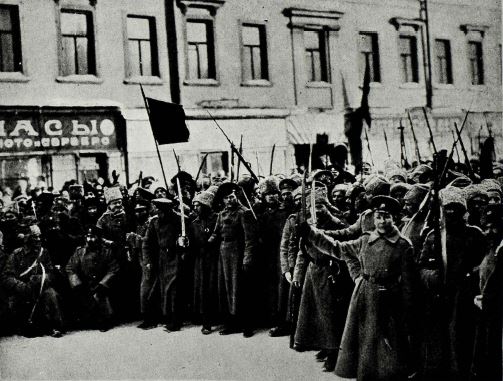
A STREET DEMONSTRATION
24.jpg
RESTORING ORDER IN THE STREETS
23.jpg
THE IMPERIAL RUSSIAN FAMILY AND BODY-GUARD: A PHOTOGRAPH TAKEN IMMEDIATELY BEFORE THE REVOLUTION. 1. The Tsar. 2. The Cesarevitch. 3. Grand Duchess Olga. 4. Grand Duchess Tatiana. S. Grand Duchess Marie. 6. Grand Duchess Anastasie
21.jpg
A RASPUTIN SEANCE


http://www.thetimes.co.uk/article/a-russian-revolution-jn6llb5rn?CMP=TNLEmail_118918_1571263


A Russian Revolution

By laying down the supreme authority of his own free will, the Tsar has saved his people from civil war and his capital from an outbreak of social anarchy
March 16, 1917
A great Revolution has been accomplished in Russia. After nearly a week of chaos in Petrograd something like a Parliamentary Government controls the situation. The Tsar has abdicated in favour of his infant son, and his brother, the reforming Grand Duke Michael, is expected to act as Regent.
The news will hardly come as a surprise to those acquainted with the internal situation in the Allied Empire as it has recently developed, and who have observed the ominous suspension of telegrams from Russia within the last few days. It has become clear for some time past that the strained relations between the Duma and the Court could not last, and that, when the crisis came, the Duma would have the nation and the Army with it. The great danger was that the Tsar might fail to realize the position with sufficient promptitude, and that he might either resist the Revolution or defer his decision. He has had enough of wisdom and of unselfish patriotism not to take either of these courses. By laying down the supreme authority of his own free will, he has saved his people, we may trust, from civil war and his capital from an outbreak of social anarchy.
It cannot be pretended that all the perils inseparable from so profound a change have yet passed away; but, so far as the available information shows, the worst moment has been lived through, and there is strong reason to hope that the transition will be completed in an orderly and peaceable manner. This expectation, we note with relief, is strengthened by the manifest eagerness of all parties that Russia should continue to wage the war with even greater vigour than she has displayed hitherto. The leaders, including the Labour leader, M Kerenski, see how fatal to this object civil dissensions of a serious character would be. They have worked hard to maintain unity, and they appear to have succeeded in a very remarkable degree. To the Tsar, in particular, the highest credit is due. Had he chosen to resist the demands of the Duma there were, doubtless, plenty of troops ready to support him. But he knew what such a choice would have meant for Russia and for the great European cause which he has served so well, and he has shrunk from the dread responsibility of making it.
The story of what has taken place is clearly still imperfect as it reaches us. Our Correspondent’s first dispatch begins with a reference to the “events of Friday,” but no account of these events has been transmitted to us. A probable explanation is that the old Government suppressed his messages, whereas the Provisional Government have facilitated the dispatch of his later accounts. These cover the period from Sunday until midnight on Wednesday, when the decision of the Tsar, on which everything was felt to hang, still remained unknown. The Revolution appears to have begun by a military insurrection supported by the workmen, but the Duma rapidly and firmly gathered power into its own hands. On Sunday the Council of Ministers resigned, and on Monday the Duma appointed a Provisional Government under the title of “The Executive Committee of the Imperial Duma”. The twelve members were taken from all the constitutional parties, from the Conservatives to the Socialists, and included such well-known personages as M Shulgin, the Conservative, M Miliukoff, the Cadet; M Shidlovsky, the leader of the Progressive bloc; M Lvov, the President of the Moscow Zemstvo, and M Chiedze, the Socialist with M Rodzianko, the President of the Imperial Duma. There appears to have been a good deal of bloodshed on- the’ Friday and Sunday, but after the Duma had assumed control the loss of life is said to have been small. By Tuesday evening the whole garrison had gone over to the Provisional Government. The Proclamations which that body issued and the speeches of M Rodzianko and other Parliamentary leaders to the troops are marked by a moderation said a cool common sense which encourage confidence in the new order of things. The first of these documents explained, as did a subsequent message from M GnaTomorr and other members of the Upper House to the Tsar, that the situation had grown impossible, and that the Duma aiai compelled to take in hand the re-establishment of the State and of public order. All good citizens were invited to work to this end, and the troops, including, the famous Preobrajenski Regiment who have taken an active share in other memorable revolutions were exhorted by M Rodzianko to show their patriotism by steady obedience to their officers. It is still too soon for entire confidence in the issue, but the general trend of events and the attitude of the Army and of the more important elements of the population justify the Allies of Russia in optimism. They may well hope that she will emerge from the ordeal she has undergone strong with the new strength of a united people, who are led by a constitutional Government of their own choosing under the auspices of their historic dynasty.
Read more »
Posted by Chestnut Trees at 02:54 No comments:
Labels: 20 століття, війна, газети, газети ПСВ, історія, ПСВ, революція, Росія

Wednesday, 29 March 2017

Трипільці і проча дрєвность в експозиції Національного історичного музею


Особливо цікаво було подивитися після дискусій щодо реконструкцій трипільського воїна для "Історії українського війська" (тема не моя, я лише спостерігав :) ) - і до речі після прочитаного за підхопленими в ході дискусії рекомендаціями "трипільського детектива"


Read more »
Posted by Chestnut Trees at 05:10 No comments:
Labels: історія, музеї, передісторія, Трипілля, Україна

Скіфи в експозиції Національного історичного музею


Read more »
Posted by Chestnut Trees at 05:04 No comments:
Labels: античність, Греція, історія, музеї, скіфи, Україна

Tuesday, 28 March 2017

Київська Русь в експозиції Національного історичного музею


Продовжимо подорож історичним музеєм - залами, присвяченими Київській Русі. Починаючи з проекта пам'ятнику Св Володимирові, який, на щастя, так і залишився лише проектом (до речі, так само як і відомий проект пам'ятника Богданові Хмельницькому, який він очевидно нагадує) В кінці - поганеньке (але яке є) фото відомого меча де нібито як напружити уяву то можна "Людота коваль" (а чи не Людовик був той Людота до речі? - якщо прочитання правильне, що зовсім не хвакт)


Read more »
Posted by Chestnut Trees at 07:29 No comments:
Labels: зброя, історія, картинки, Київ, музеї, Русь, Україна

Ранньомодерні часи в експозиції Національного історичного музею


На жаль, ці два зали досить скромні - але вже що є
Read more »
Posted by Chestnut Trees at 07:22 No comments:
Labels: 15 століття, 16 століття, 17 століття, зброя, історія, картинки, козацтво, Польща, ранні нові часи, Україна
Newer Posts Older Posts Home
Subscribe to: Posts (Atom)

Feedjit

About Me

Chestnut Trees
View my complete profile

Blog Archive

  • ▼  2025 (43)
    • ▼  June (3)
      • Хрестовий похід у Європу ілюстрації до розділів 11...
      • Хрестовий похід у Європу, ілюстрації до розділів 9...
      • Хрестовий похід у Європу, ілюстрації - мапи до роз...
    • ►  May (24)
    • ►  April (16)
  • ►  2024 (6)
    • ►  September (1)
    • ►  July (2)
    • ►  June (2)
    • ►  March (1)
  • ►  2023 (1)
    • ►  November (1)
  • ►  2022 (11)
    • ►  August (1)
    • ►  April (3)
    • ►  February (2)
    • ►  January (5)
  • ►  2021 (53)
    • ►  December (13)
    • ►  November (4)
    • ►  October (12)
    • ►  September (7)
    • ►  August (1)
    • ►  April (1)
    • ►  March (13)
    • ►  February (2)
  • ►  2020 (1)
    • ►  February (1)
  • ►  2019 (3)
    • ►  November (1)
    • ►  October (1)
    • ►  August (1)
  • ►  2018 (322)
    • ►  November (21)
    • ►  October (25)
    • ►  September (13)
    • ►  August (29)
    • ►  July (22)
    • ►  June (25)
    • ►  May (20)
    • ►  April (30)
    • ►  March (48)
    • ►  February (36)
    • ►  January (53)
  • ►  2017 (210)
    • ►  December (18)
    • ►  November (23)
    • ►  October (21)
    • ►  September (25)
    • ►  August (10)
    • ►  July (15)
    • ►  June (12)
    • ►  May (21)
    • ►  April (7)
    • ►  March (37)
    • ►  February (12)
    • ►  January (9)
  • ►  2016 (2)
    • ►  May (2)
  • ►  2015 (5)
    • ►  February (2)
    • ►  January (3)
  • ►  2014 (22)
    • ►  December (4)
    • ►  November (2)
    • ►  October (7)
    • ►  July (1)
    • ►  May (1)
    • ►  April (5)
    • ►  January (2)
  • ►  2012 (1)
    • ►  January (1)
  • ►  2011 (5)
    • ►  November (3)
    • ►  October (1)
    • ►  June (1)
  • ►  2010 (66)
    • ►  October (2)
    • ►  September (1)
    • ►  July (9)
    • ►  April (3)
    • ►  March (38)
    • ►  February (13)
  • ►  2009 (1)
    • ►  October (1)

Followers

Picture Window theme. Powered by Blogger.