Showing posts with label Росія. Show all posts

Thursday, 15 November 2018

Contextualising a certain short film


http://www.thetimes.co.uk/tto/archive/first-world-war/article4538855.ece 

Fall of Osowiec reported The German main headquarters state that, aIthough no definite figures of the booty taken at the fall of Kovno are yet to hand, the number of prisoners is more than 20,000. More than 600 cannon were captured, many of which are modern heavy ones
Another Russian fortress is reported to have fallen into the hands of the Germans. The announcement is made from Berlin that Osowiec, has been occupied by the troops under General von Eichhorn after it had been evacuated by the Russians. There is as yet no confirmation of the event from Petrograd. Osowiec, though it ranked only as a minor fortress has, on three occasions at least, played a distinguished part in checking previous German invasions of Poland. Situated on the Bobr, with Augustowo to the north and Bielsk to the south, it defended the only good passage across the swampy valley of marshes through which the river flows.

THE GERMAN CLAIM.
Berlin, Aug 23. German official report: Marshal von Hindenburg’s Army. The troops under General von Eichhorn are further advancing east and south of Kovno. On the Bobr we occupied the fortress of Osowiec, which was evacuated by the Russians. North and south of Tykocin successful fighting took place. We captured Tykecin, taking 1,200 prisoners, among them 11 officers. Seven machine-guns also fell into our hands.
[The Wireless Press version of the communique gives the number of machine-guns captured as 77. It adds that “desperate Russian counter-attacks east of Bielsk failed, with very considerable losses to the enemy. We advanced south of this town.”]
ARMY GROUP OF MARSHAL VON MACKENSEN. The enemy put up a tenacious resistance between Razna and the Bug. An attack across the Bug above the Pulwa sector is progressing. Before Brest Litowsk the situation is unchanged. On both sides of the Lakes of Switjas and near Piszcza, east of Wlodawa, the enemy was defeated yesterday and driven north-eastwards. Reuter.
The Wireless Press reports the following from Berlin in addition to the above: The Army of Prince Leopold of Bavaria. Accompanied by stubborn fighting this Army group has crossed the Kleszczele-Razna line and is engaged in further favourable attacks. Three thousand and fifty prisoners were taken and 16 machine guns captured.
[Yesterday’s German official report stated that Prince Leopold’s Army group crossed the Kleszczele-Wysoko Litowsk railway on Saturday and captured over 3,000 prisoners and a number of machine guns.]

Monday, 12 November 2018

100 Years Ago


Stand by. Unfix bayonets

The British Army began its first battle of the war at Mons on August 22, 1914, and, by the grace of God, our troops stood in this same spot when the order came to cease fire. That the enemy had made up his mind that the end had come, our troops yesterday had ample evidence. On most of the front they marched and rode almost as they pleased. The news of the armistice was got forward to our far-flung patrols and batteries with great promptitude, and a great silence fell upon the land after 11 o’clock. There can be no harm now in saying that the message had been expected, and there had been ample time to signal the news beyond the points where telegraph and telephone cease. Our scattered troops were told to unfix bayonets and unload magazines and to stand to for further orders. No attempt was to be made to fraternize with the enemy. I believe there was some demonstrativeness on the German side, and I hear of German troops seen trying to break their rifles or throw them away. But, on the whole, the great tidings appear to have been taken pretty quietly. Amongst the troops in rest there was more jubilation. At headquarters close to the line parades had been arranged of all available troops as soon as the news was received, and at 11 o’clock the bugles sounded the “Cease fire” and the bands played the “Marseillaise” and “God Save the King”. Many then broke out into “Tipperary”, which the peasantry seem to imagine is our National Anthem, to judge by the respect with which they hearkened to the strains.
Shortly after 11 o’clock the roads presented an extraordinary scene. Refugees began to stream back in swarms. The Germans are manifestly anxious to show their good faith, for very shortly after the armistice dispatch riders were bringing into Corps Headquarters full details of the positions of all mines, booby traps, and leads, which had been sent over under the white flag by enemy commands.
The day is grey and drizzling, which does not conduce to outdoor demonstrations on the part of people who have suffered much, and many of whom cannot yet tell how many of their dear ones have fallen in the terrible struggle. Silent thankfulness is the prevailing sentiment today in the war area of Northern France.

Friday, 14 September 2018

This week in history - The Battle of the Alma (15-22 September 1854) - 2

У кігтях двоглавих орлів

https://www.bookclub.ua/catalog/e-books/e-books-facts/product.html?id=39732

Битва на Альмі

Висадження франко-британо-турецького десанту біля Євпаторії стало повною несподіванкою для росіян. Російськими військами командував недавній імператорський посланець до Стамбула князь Меншиков, чиї дії багато в чому посприяли розв’язуванню війни.

Він не виявився успішнішим у ролі полководця, ніж у ролі дипломата. Щоб заступити союзникам шлях на Севастополь, він вибрав для своєї 36-тисячної армії сильну оборонну позицію на пагорбах на правому (південному) березі невеликої річки Альма, біля її гирла. Російські позиції прикривали 96 гармат, у тому числі розміщених у двох польових укріпленнях. Меншиков вважав, що урвища біля моря, на його лівому фланзі, не дадуть союзникам можливості атакувати в цьому місці, то ж там він залишив тільки невелике прикриття. Крім того, він побоювався, що війська, розміщені біля моря, можуть бути обстріляні великим союзним флотом.

Російській армії протистояли 56 тисяч французів, британців і турків із 122 гарматами — менше на кілька тисяч від числа, висадженого в Євпаторії, бо частина вже заслабла від холери, у тому числі й маршал Сент-Арно. Праворуч, біля моря, стали французи, ліворуч — британці, за ними — турки. Через обмаль кавалерії не було можливості обійти російське військо з лівого крила союзників. Сент-Арно і Раґлан вирішили, що французи почнуть атаку першими проти, як вони думали, головних російських сил (виявилося, що є стежка, якою можна провести солдатів на «неприступні» урвища,), а за ними на своєму крилі атакують британці.

Thursday, 13 September 2018

this week in history - The Battle of the Alma (15-22 September 1854)


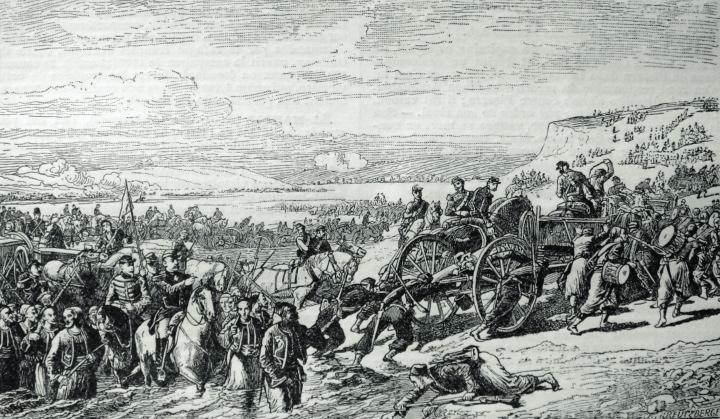
Francuska artyleria podczas bitwy nad Almą, rycina z epoki


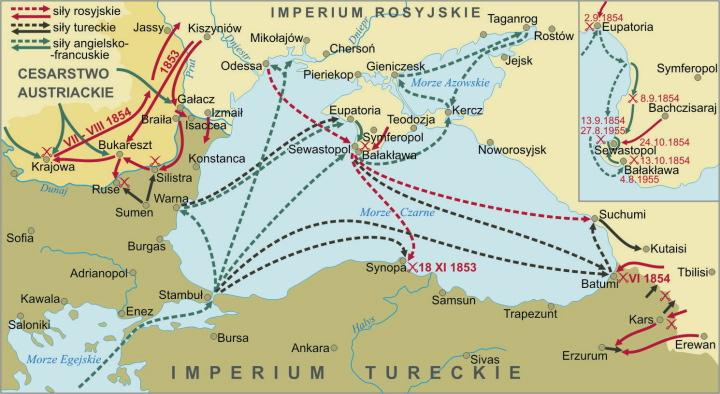
The British, French and Turkish forces landed on the Crimean Peninsula over four days between 14 and 18 September. The next day, they started their march south to Sevastopol, following a route which would take them across four separate rivers. The first day, they avoided an ambush at Bulganek river, and the next they recommenced their march to the river Alma. The commander of the expedition, Lord Raglan, knew from naval sources that Russian forces had been amassing south of the river, and approached carefully, but a battle was inevitable. After fierce fighting, the allies were victorious against the Russians, but this outcome was not inevitable, and a Russian victory could have meant a premature end to the entire Crimean campaign. As it was, the allies could continue south to Sevastopol, where the siege of the port started on 27 September. Just over a month later, the infamous Charge of the Light Brigade rode towards the Russian guns at Balaclava.

Further Reading

Essential Histories 2: The Crimean War 1854-6 gives a complete account of the war, its context and consequences. Campaign 6: Balaclava 1854 The Charge of the Light Brigade and Campaign 51: Inkerman 1854 The Soldiers' Battle detail two of the later battles of the Crimean War. To learn about the armies involved in the war, turn to Men-at-Arms 241: The Russian Army of the Crimean War 1854-56 and Men-at-Arms 196: The British Army on Campaign (2) The Crimea 1854-56. Elite 71: Queen Victoria's Commanders gives accounts of the careers and personalities of some of the commanders leading the British troops in the Crimea.

Wednesday, 5 September 2018

100 Years Ago - The Bolshevist murder


The Bolshevist murder

Bolshevist soldiers have broken into and sacked the British Embassy at Petrograd, looted the Embassy, destroyed the papers, murdered Captain Cromie, the British Naval Attache, who gallantly defended the building, mutilated his body, and even refused an English clergyman leave to pray over the dead. Our Government telegraphed to the People’s Commissary for Foreign Affairs a demand for immediate reparation and for the prompt punishment of all concerned. By the immemorial law of all communities who have emerged from primitive barbarism the persons and domiciles of foreign representatives are sacrosanct. The British people will regard this infamous act with the deepest horror and indignation, and require that searching and impartial investigation shall be made as to responsibility for the deed. We do not want hecatombs of the ruling party’s political enemies, such as they offered to the Germans after the murder of Count Mirbach, or executions confined to insignificant underlings. The report of the murder given in the official Bolshevist organ shows that the armed invasion of the Embassy was the considered act of the Soviet Government, and not a mere outbreak of irresponsible brigandage.
The Government have warned of the measures they will take if the Soviet Government fail to give complete satisfaction. About a hundred of our fellow-countrymen, including our distinguished Petrograd Correspondent, are believed to be still in Bolshevist Russia. There are also Bolshevists in England, among them M Litvinoff, the representative of the Soviet Government, and his staff. They have been placed under arrest until all British subjects under Bolshevist control have been set at liberty and allowed to proceed to the Finnish frontier. A group of 25 were to have left our shores on Tuesday, as a token of our good will, although negotiations for the mutual repatriation of British and Russian citizens had not been concluded. The treaties signed by the Bolshevists with Germany on Tuesday provide, we are told, that Russia will fight against the Entente in Northern Russia. If this is correct, they would seem to regard themselves as in a state of war with us. But only savages begin war by assassination.

Monday, 3 September 2018

В очікуванні виходу нової книги порекламую старі - 6

https://www.bookclub.ua/catalog/books/facts/product.html?id=39203

Історія українського війська


Рядовий Українського єгерського полку, 1854 р.

Автори реконструкції: А. Галушка, О. Ком’яхов

Під час Кримської війни полк носив номер 23, пізніше нумерація піхотних полків зміниться. Цей номер видно на щиті емблеми у вигляді орла на касці солдата. Такі гостроверхі каски (з чорної шкіри із бронзовими деталями та з підкладкою із шкіри та полотна) російська піхота отримала у 1844 р. Конструкцію каски розробив імператор Микола І за мотивами давньоруських шоломів. У 1849 р. було введено дещо змінену модель каски. Чохлів для касок не було запроваджено, тому під час кампаній шкіра каски, потрапивши кілька разів по черзі під дощ та під сонце, коробилася й тріскалася. Солдати надавали перевагу «фуражним шапкам»-безкозиркам. Під час Кримської війни в армійській піхоті каски замінили на циліндрічні ківери, але це сталося лише у 1855 році.

Солдат носить довгу шинель із грубого сірого сукна із темно-зеленим коміром. Щоб шинель не заважала під час ходи, її підвертали різними способами — у непідвернутому вигляді вона доходила майже до п’ят. На шинелі сині погони із жовтим номером дивізії, в цьому випадку «12». Сині погони були в першого єгерського полку кожної піхотної дивізії, у другого (для 12-ї дивізії це був Одеський полк) погони були темно-зелені.

Під шинеллю у солдата темно-зелений мундир. Взимку з ним носили темно-зелені суконні штани, а влітку — світлі полотняні. На відміну від піхотних полків, ремені однострою єгерських полків були не білі, а чорні. Солдат не має ранця (із телячої шкіри з шерстю), бо, щоб прискорити марш, полк залишив їх у Перекопі. Фон малюнка (море й намети британського табору коло Балаклави) натякає а Балаклавську битву у жовтні 1854 р., де солдати Українського єгерського полку штурмували турецькі редути на горбах уздовж Воронцовської ороги. Солдат саме стоїть на цьому горбі та дивиться на долину, де була атака британської Легкої ригади кавалерії.

Зауважимо, що у 12-й дивізії, окрім Українського Одеського єгерських полків, були Азовський і Дніпровський піхотні полки, що також брали участь у Балаклавській битві. Дивізія була перекинута в Крим Дунайського театру війни і повністю не відновилася після втрат.

Солдат озброєний «літтіхським штуцером» зразка 1843 р. (копія британської «брунсвікської гвинтівки» 1836 р., яку виробляли зброярні у місті Льєж (німецькою Літтіх) у Бельгії). Штуцери давали кращим стрільцям у батальйоні; 6 чоловік у кожній роті разом складали «штуцерну команду» із 24 стрільців. Ця гвинтівка мала калібр 7 ліній (17,9 мм), довжину 1,16 м, вагу 4,14 кг, максимальну дальність пострілу 800 м, але ефективну дальність лише 300 м. Куля важила майже 50 г. Капсулі для штуцера зберігаються у маленькому чорному шкіряному підсумку, закріпленому на ремені, що носиться через ліве плече. Для рукопашного бою солдат має на боці тесак, який можна примкнути до штуцера як багнет (але стріляти з примкнутим багнетом неможливо). Довжина тесака 67 см разом із руків’ям, довжина гострого з обох боків леза — 56 см, вага — 1 кг.

У кігтях двоглавих орлів


Балаклава й Інкерман

Російське командування усвідомлювало, що союзники готуються до рішучого штурму Севастополя. Щоб деблокувати місто, або хоча б відволікти сили союзників від організації штурму, князь Меншиков прийняв рішення атакуватии позиції союзників неподалік Балаклави, тилової бази британських експедиційних сил. Очолив 25-тисячний російський корпус генерал Ліпранді. 13 (25) жовтня 1854 р. російська піхота захопила кілька польових укріплень (редутів), що захищали дорогу від Балаклави до британського табору. На чолі цієї атаки йшли Азовський[1], Український, Дніпровський, Одеський єгерські полки, перекинуті в Крим із Дунайського театру воєнних дій. Але цей успіх не був розвинутий. Російська кавалерійська бригада, половину якої складали 8 ескадронів  Київського гусарського полку, не витримала удару британської Важкої бригади кавалерії, і не змогла розбити єдиний британський батальон, що стояв мііж нею і Балаклавою. Пізніша самогубча атака британської Легкої бригади кавалерії (із 670 її солдатів і офіцерів 247 було вбито, поранено чи попало в полон, загинуло 497 коней) на російські гармати дала можливість російському командуванню казати про велику перемогу в цьому бою. Свідок цієї атаки французький генерал Боске начебто сказав: «Це чудово, але це не війна». Втрати обох сторін були рівні: в бою загинуло приблизно 600 росіян, 300 британців, 250 турків і 40 французів.

Thursday, 30 August 2018

100 Years Ago


French dash to the Somme

The Germans are retreating as fast as they dare, as fast, that is, as they can without retreat degenerating into a rout. They are covering the same ground as that over which they retired in the spring of 1917 about as quickly as they did then, but with this great difference — that this time the Allies are close on their heels.
The towns and villages that fall one by one into the hands of the advancing troops are a sorry sight. They are battered out of all recognition. Most of them I know, some of them well. When I went to Moreuil and Montdidier I simply did not recognize them. I could not place any of the houses and not many of the streets I had known. Looked at from the west, Montdidier is a particularly gruesome spectacle. It is not only that the insides of the houses are exposed. The very foundations of the town are laid bare. They seem to have been turned inside out, and upside down. It is like looking at a grave that has been burst open and violated. The naked cliff of sandstone on which it stands is thrown open to view instead of being hidden by a clustering mass of houses, and cliff and fallen stonework form a formless jumble of chaos and destruction which in no way suggests that it could ever have been the handiwork of man.
Roye, fortunately, is not so bad. Some of the streets have been blown up by mines; the church and a certain number of houses have been destroyed by shells, but it still looks like a town, and there are still houses standing, on the walls of which the Germans have left characteristic inscriptions as a trace of their occupation. The brick ramparts overhanging the Avre facing west across the Santerre Plateau have suffered particularly badly, but they are picturesque in their ruin. It is not much consolation to reflect that in the case of these recently destroyed places the ruin is mostly the result of the fair wear and tear of war. But it is in a way comforting to feel that the Germans must by now be bitterly regretting the wantonness with which they blotted out of existence with fire and dynamite during their last retreat the towns and villages of behind their present line. They are in something the same plight as the ancient wanderers in the wilderness, whose soul fainted within them because they found no city to dwell in. And it is their own doing.

Thursday, 16 August 2018

100 Years Ago


One of the finest fights the Canadian cavalry have been in was on Sunday morning on the Amiens-Roye road, between Goyencourt and Andechy. Two giant pill-boxes of heavy steel and cement stand sentinel over the main road and two cross-roads. They held up our infantry during the first Somme advance, and although the concussion from our heavy shells killed most of the garrisons, the forts were not destroyed. After the advance they were strengthened, and used for defence in the March Allied retirement. A hasty attempt to blow them up was unsuccessful.
Now, they once more frowned on the attacking troops. A force of Canadian cavalry divided into small parties and spread over tracks which led towards the redoubts. The German outposts were surprised and killed, and there seemed a chance of gaining the position by surprise. The garrison’s attention was taken up by minor fights on either side, when suddenly a party of the Canadian cavalry charged down the main road to within 50 yards of the little forts, when they encountered barbed wire and were held up. They had considerable losses in men and horses from machine-gun fire. The mounted men galloped to shelter, but the troopers who had been dismounted, sheltered by their dead horses and what cover they could get, went on cutting wire. With a semblance of a path cut through, the cavalry commander, in conjunction with some whippet Tanks, launched another party. Guided by their unmounted comrades, the troops got through the first wire and were right on top of the positions. They fired point-blank into the little forts, and then swerved to the right into the shelter of a small wood. There were a considerable number of casualties, but the German garrisons, panic-stricken at the closeness of the horsemen and afraid of being cut off, fled out through the rear trenches. The gaining of the position meant everything to the British and French infantry. It was one of the hardest fights Canadian cavalry have been in during this tremendous battle.
The motor machine-gunners have a new mascot in a fine Dachshund bitch they took from a dugout where she refused to leave the body of her master, an officer. She is suffering from shell shock and whines at every explosion, but the unit means to bring her back to Canada.

Wednesday, 8 August 2018

100 Years Ago


Forward with the Americans


New murder traps have been set by the Germans to catch unwary Americans in the towns and cities from which the enemy has been driven. On the floors in houses were found glass bulbs or bladders, full of phosgene gas to poison our men when entering. Other deposits of the same gas were left in tiny bags under helmets, as the Germans know that souvenir collecting is a passion of Americans. The captain who led the advance patrol of 30 Americans into a captured town saw in the dining-room of a small hotel a loaf of bread on the table, with a knife sticking in it. Suspecting a snare, he called upon a German prisoner to withdraw the knife. The effect was a violent explosion. A bomb had been left in the loaf, but only the prisoner was injured. When the captain reached the hotel a German officer came out, speaking excellent English, saying he desired to surrender. The American pulled out his revolver and jumped back barely in time to escape a rain of bullets from a machine-gun hidden under a cellar door.
Machine-guns, which have practically supplanted rifles with the Germans, are the bane of the overseas soldier, yet the Americans throw themselves against the pernicious weapons with almost superhuman audacity. Set up in rocky nests, clumps of bushes, or along ridges commanding fields of uncut grain, they are handled by an experienced enemy who keeps his presence of mind and offers the most desperate resistance before his opponents can come to hand-to-hand conflicts, where the superiority of the fresh and well-fed American troops always manifests itself
In the operating room of a hospital left by the enemy were some rolls of crepe paper, which the Germans have been using for dressing wounds, showing they have little cloth left. We also discovered that some burned bits of harness, instead of leather, were made from composite paper and hemp. A number of motor-cars burned and abandoned by the Germans in their flight had iron tires, indicating that the enemy was out of rubber. Millions of dollars’ worth of German supplies have been destroyed by the retreating enemy. The horizon at night is a succession of gigantic red patches, with occasional roars of touched-off ammunition which they could not remove.

Thursday, 2 August 2018

100 Years Ago


The Scots at Buzancy

A week ago I suppose there was hardly a soul in Scotland who had heard of Buzancy, which is one of the gates of the plateau on its western side. Today there is no prouder name borne on the colours of the eight famous regiments by which it was stormed. The Scottish Division has done no harder fighting during the war. The violence of the struggle was frightful. A great deal of it was hand-to-hand fighting in the streets. At the end of the day two bodies were found locked together in death. One was a German officer, in his hand the revolver with which he had shot his opponent. Our man was still holding the rifle with which he had bayoneted the officer as he fired the shot which killed him. The village and the sandstone caves were stiff with machine-guns. At one place there was a high wall which had to be crossed. Our men got over it by climbing on each others’ shoulders, and dropping on the other side in face of a terrible fire. The enemy showed no trace of the failing moral which is too freely talked about. Almost to a man they resisted to the very last, and after the battle several German machine-guns and one Tank were found with the men dead at their posts, and a ring of our dead and wounded close up to them.
The division had already had a strenuous time. They were brought back from Arras after seven months in the line, entrained at 2 in the morning and then moved to their new quarters in motor-omnibuses and, at the end of a 10-miles march, ordered to attack at daybreak. After a great fight, though exposed to galling machine-gun fire on their flanks, they reached their objective, consolidated their position, and held it till the morning of the 26th. Next day came the order for the attack on Buzancy and the high ground beyond, and by midday on the 28th the first wave was through and the objectives attained. Then, however, there was a hitch, as the troops on the right, in spite of the most gallant efforts, could not advance, and were compelled to fall back.
The difficulty about the position is that it is enfiladed by German heavy batteries. The valleys behind the lines are doused with gas, and as, except in the caves, there is almost no shelter, the troops have need of philosophy, as well as courage, to stick it as they do. The whole countryside is horribly devastated.

Thursday, 26 July 2018

100 Years Ago

Clearing the Marne woods

There is now no question about it. The Germans are in retreat. South of Fere-en-Tardenois, the one railhead that is left them — and that has been heavily shelled by the French — they have been busily burning stores too bulky to be quickly removed, and not only most of their guns but the greater part of their infantry have gone. Some of those who have been left behind seem to have little stomach left for fighting. One member of the Staff, who had seen columns of troops and supply convoys moving away to the north, told me of an incident which gives a picture of the state of mind to which some of them have been brought. They did not appreciate the efforts of the French gunners, and a number of them near whom a shell fell scattered, as he said, like a flock of sparrows, and refused to come back to their posts till their Unteroffziere had beaten them with canes. It happened not once but four or five times to the same lot of men.
It was a more dangerous enemy, however, that the French had to deal with yesterday. In every possible hole or corner in the woods the Germans as they fell back had left squads of machine-gunners to gain delay for the troops in retreat. To attempt to clear out these nests of wasps by frontal attacks would have meant great loss of life. The alternative was to advance in the open on each side of the woods, leaving them for other troops to deal with later on from the flank and from the rear. Today, the Bois de Chatelet and the Bois de la Tournelle, which were passed in yesterday’s advance, will be cleaned up by Americans and tirailleurs.
I stopped yesterday on the near side of the Bois de Chatelet, near enough to appreciate one striking proof of the difference of the fighting in this open warfare from what it was even a year ago. Whereas the woods in the old days were shelled till there was not a stick left, the Chatelet Wood and others that I passed still had their coating of leaves, and though here and there a trunk was cut through, you would hardly have suspected that war had passed their way. And yet the plan of turning them during an advance and clearing them out afterwards with grenades and bayonets from the rear is far more effective than the old-fashioned shelling in ridding them of their destructive occupants.

Friday, 13 July 2018

100 Years Ago


Australians’ exploits at Merris

An interesting adventure in patrol tactics is proceeding near Merris, where, in full daylight and without artillery or trench-mortar assistance, small groups of Australians carried forward our line within 500 yards of Merris over a front of 2,200 yards. They captured more than 150 men, including officers. Mere handfuls of men were employed in this success. In the morning two patrols, busy in maintaining our hold on No Man’s Land, were working along the railway when four of their number, separated from the rest, came upon some 40 Germans near a farmhouse and captured the whole group. The event caused some rivalry and further expeditions were organized, and during the whole day groups of prisoners were continually coming back to the cages. One sergeant was told that he would be excused some task which he disliked if he would fetch six German prisoners. He suggested that the number was rather excessive, but the officer was adamant. So, in company with a soldier from his company, he set out, and reported an hour or two later with a queue of eight Germans behind him. The reserve troops from whom the prisoners were taken had just relieved the Bavarian Division in which some indiscipline was recently reported. It would not be true to suggest that the moral of the better German divisions is obviously reduced, but there is no doubt that in this sector the enemy are cowed by the dash and originality of the Australian patrols. In the Merris sector, which is very different from the positions on the Somme, no strong, or even regular, line has yet been dug, but before this advance the enemy had a chain of fortified posts forming an awkward salient into our lines, and this is now completely straightened out.
The whole Air Service is in great grief at the loss of Major McCudden. He was on his way from Scotland to take up a new command, and flew over from England in his favourite single-seater. He landed at an aerodrome in Northern France, where he had business, and, after a short stay, set off again to join his squadron. While only a few hundred feet from the ground his machine side-slipped and crashed among trees. He was killed instantly. The official record of his victories is 45 enemy aeroplanes brought down and 13 driven down.

Thursday, 21 June 2018

Professor Richard Pipes obituary

https://www.thetimes.co.uk/past-six-days/2018-06-20/register/professor-richard-pipes-obituary-hfvg5wggd


Historian who escaped from the Nazis and spent his life warning of the dangers posed by the authoritarian regime in the Soviet Union
Richard Pipes at Harvard, where he taught for almost 40 years, in 1991
Richard Pipes at Harvard, where he taught for almost 40 years, in 1991AP

When Richard Pipes, a young Polish-Jewish emigrant to the United States, began in 1945 to discover what had happened to much of his extended family during the Holocaust, he made a number of life-changing decisions. After reading letters from a few surviving relatives about brutal deportations and death camps, he avoided pursuing much more knowledge “for the sake of my sanity and positive attitude to life”. At the same time, he concluded that his own immediate family’s miraculous escape from Nazi-occupied Poland in 1940 should make him “delight in every day of life that has been granted to me, for I was saved from certain death”.
His life was not to be wasted, but used “to spread a moral message by showing, using examples from history, how evil ideas lead to evil consequences”. Rather than studying the horrors perpetrated by the Nazis, “I thought it my mission to demonstrate this truth using the example of communism”.
Pipes went on to make his career at Harvard where he became one of the best-known historians of Russia and the Soviet Union. He saw significant continuities between tsarist imperialism and authoritarianism and what followed the 1917 Revolution, and wrote unfashionably and unflinchingly about the personal evils and culpability of communist leaders such as Lenin and Stalin. And he took his academic perspective of Russian behaviour into a brief but highly influential political role as an adviser to President Reagan in the early 1980s, persuading him to adopt a less compromising approach towards Moscow in the belief that the Soviet Union could not survive a sustained economic and military challenge.
Such was Pipes’s prominence that the Kremlin published a book denouncing him as the “Falsifier of History”. While critics accused him of Russophobia, Pipes insisted that “I draw a sharp distinction between Russian governments and the Russian people”.

Tuesday, 5 June 2018

First World War: Bolshevik and artistic revolution in Russia

https://www.thetimes.co.uk/past-six-days/2018-06-02/register/first-world-war-bolshevik-and-artistic-revolution-in-russia-3m9t3d979


Initially dismissed as ‘trivial matters’, the arts soon became a vehicle for political advantage in the new Soviet Union
Soviet soldiers reenact the storming of the Winter Palace three years to the day after it happened
Soviet soldiers reenact the storming of the Winter Palace ten years to the day after it happened


When one looks at any illustration of the storming of St Petersburg’s Winter Palace in October 1917 — and there are many, varying from those based on the original photographs to more dramatic representations — one might ask: “Where were the artists, ballerinas, poets, sopranos and writers on that historic evening?” The answer is “cheering on the mob”, either actually or in their hearts.
The Bolshevik-led revolution struck Russia in the middle of the so-called Silver Age, in which the artistic avant-garde were producing work in an iconoclastic surge, ridiculing the bourgeois and forecasting a new society of realism and “the people”. Unsurprisingly this phenomenon was seized upon by the Bolsheviks as a public relations vehicle for the propagation of their aims, principles and programmes.

100 Years Ago


War pictures by Mr Orpen and Mr Nash

Mr William Orpen, ARA, has been to the war, and many will go to Messrs Agnew’s Gallery to see how he has adjusted himself to it. As a matter of fact, he has adjusted the war to himself. He can always find a formula for anything; and even for the war he has found formulae such as he used to find for Irish scenes, for fashionable ladies, for anything he chose to paint. He has merely applied an old formulae to a new subject. There is the falling bomb, with a Goya formula. It was real when Goya used it; but it is not real in Mr Orpen’s hands. He gives us horror, in his “Dead Germans in a Trench”. The Censor has passed this, though he would not pass a picture by Mr Nevinson of a dead Englishman, his aim being apparently to persuade us that only Germans die in this war. On the whole we feel that Mr Orpen has remained too much a master of himself and his theme. We wish the theme had sometimes mastered him.
Mr Paul Nash, who has also been to the war, and whose war pictures are at the Leicester Galleries, has adjusted himself to it much more. He is usually a romantic artist: in these works his romance has turned to irony. This is a beautiful and wonderful world, he seems to say; and see what man has made of it. See also how even man’s insanity cannot rob the tortured and battered earth of its beauty. In many of his drawings he has been struck by the strange, unaccountable beauty of the meaningless shapes of things so tortured and battered. They make an abstract music of their own, like that abstract music of form that the cubist tries to make for himself. Mr Nash has not had to make it; it was there for him to see; utter chaos, as of a world dead for a million years, frozen and without atmosphere, and yet beautiful to frightened human eyes. You feel that it has been seen with frightened eyes, frightened at the inhumanity of it. It is waste — the waste of worlds, of ages, which looks as if it had been made by some indifferent will of Nature. Then we remember that it has been made by man in his babyish will to power. That is the effect these drawings have on us. Like all good drawings of the war, they might be used in the propaganda of a league of peace. They might appal even a Junker, if he were not too stupid to think of anything but the word of command.

Thursday, 24 May 2018

100 Years Ago


Prisoners at Ruhleben

We have been informed by a British journalist who suffered internment in Ruhleben for two-and-a-half years that, owing to the fact that the prisoners receive no vegetables at all and no fats — practically living only on tinned stuff — the condition into which the prisoners have fallen is appalling. In his own case the entire absence of these necessary food constituents caused prolapsus of the stomach, the body commencing to feed on its own tissues and muscles. Ruptures were frequent. If the prisoners requested a belt they were given one, but the German “doctors” never inquired into the cause.
A wealthy man can — as some did — by giving a big commission to the camp commandant, get clothes, bedding, and a little furniture. These fortunate ones would pay to get their horse stall or shed cleaned out, and then install their heavily paid-for bits of furniture. These were the places shown to the American Ambassador on his visits, and on which his earlier reports as to the condition of British prisoners were founded. He was carefully piloted to that part of the camp where the prisoners had been allowed to make the best of their plight and was guided away from places it was undesirable he should see. The Germans always knew beforehand of these visits, and made preparations. But one day Mr Jackson, of the United States Embassy in Berlin, after being carefully engineered through the “show part,” evinced a desire to see another part of the camp. In spite of the efforts of the German Staff to prevent him, he walked to that part of the camp which had heretofore been avoided. He was greeted with cries of “Bravo, Jackson!” by the unlucky men imprisoned there, who shouted, “See Barrack No 6! See Barrack No 5!” as the officials again tried to get him away. The report Mr Jackson made of this part of the camp brought an immediate visit from the Ambassador, who was most indignant, and there and then (in our correspondent’s words) “went for” the Germans. Our informant, in spite of the fact that he has now been back for nearly a year, is still in a deplorable physical state. He has four ruptures, his body and arms are covered with sores, and he is semi-blind. All the deaths that occurred, including those due to neglect and ill-treatment, were put down to typhus by the Germans.

Thursday, 17 May 2018

100 Years Ago - Petrograd famine, ex-Tsar

https://www.thetimes.co.uk/edition/register/grave-plight-of-petrograd-pqltmnttd


Grave plight of Petrograd

The famine in Petrograd is becoming alarming. There is practically no food on the markets or in the shops. There is no flour, no sugar, potatoes, cheese, or milk, no grains and very little meat. The necessaries of life have to be got through friends at enormous cost, if you have the money, as the meagre rations doled out by the authorities are absolutely inadequate. The ration of indigestible black bread, half-baked, with water in it to increase the weight, is only one-eighth of a pound per day, and often that is not forthcoming on account of the hopeless disorder and universal thieving. Relatives and dependents rob one another of food without compunction. Hunger has no conscience. In spite of stringent measures against hoarding and speculation, profiteering goes on among all classes. In fact, food is a far more valuable commodity than paper money. Half the working day is wasted in pursuit of sufficient to eat. No fewer than 15 cartloads of rotten hares were recently brought into the town and several attempts were made to foist them onto the municipal executive, but they were finally rejected. Good hares are being sold at £2 10s apiece.
The prices of other articles are fabulous. Hams are £40 and £60 each. Butter costs 42s a lb. The British community of Petrograd, which is now reduced to about 500 persons who were unable, for various reasons, to leave Russia, have felt obliged to induce the British Consul and the incumbent of the English church to wire to London for a few supplies to tide us over this crisis. I am told that a telegram has been sent to the Foreign Office, but so far no assistance is forthcoming. We do not want luxuries, but a few cases of oats, some sugar, margarine and flour, would be a godsend.
The only change for the better has been in the weather. The ice and frozen filth covering the roads two or three feet deep was broken up by gangs of men and women with whom the bourgeois were requisitioned to cooperate, and at some places they were to be seen plying pick and shovel under the supervision of armed soldiers of the Red Guard. Resisting or, as the revolutionary jargon now goes, “sabotaging” persons who objected to take part were threatened with heavy fines and imprisonment.

Friday, 27 April 2018

First World War: Bloody conflict in oil-rich Baku

https://www.thetimes.co.uk/edition/register/first-world-war-bloody-conflict-in-oil-rich-baku-390xgjwst


As London turned its attention to the Caucasus, fighting between Bolsheviks and Muslims plunged the city into chaos


Men working in the thick smoke of the Baku oilfields on December 1, 1918

Wednesday, 4 April 2018

First World War: Lenin’s pragmatic approach to Russia’s Islamic regions


https://www.thetimes.co.uk/edition/register/first-world-war-lenins-pragmatic-approach-to-russias-islamic-regions-t3tsqtpdk


An open-mindedness towards Muslim issues by the Bolshevik leader was welcomed during the early days of the revolution
Lenin sweeps away the old ways, including in 1917 removing special privileges based on faith or nationality
Lenin sweeps away the old ways, including in 1917 removing special privileges based on faith or nationalityREX FEATURES
Writing in the Bolshevik newspaper Novaya Zhizn (New Life) in 1905, Vladimir Lenin pronounced: “As a system of belief, religion adds to the oppressive woes of the exploited, coarsening and darkening the spiritual and moral life of the masses.”
An atheist from age 16, this reflected his thinking of religion broadly and did not take account of the likely obstacles that Islam would place on the spread of Bolshevism. This was a surprising omission because the census of 1897 revealed almost 14 million Muslims mainly living in the Caucasus, the Volga-Ural regions and Azerbaijan, Kazakhstan, Kirghizia, Tajikistan, Turkmenistan and Uzbekistan. These regions considered themselves suppressed by the tsars and the widespread rejoicing that greeted the fall of Nicholas II might have given Lenin grounds for optimism for their willing adoption of his political and social convictions. When conflict between Bolshevism and religion began to emerge as an issue of importance, he was to prove more pragmatic in his approach to Islam than to the various schisms of the Christian faith.
Shortly before he moved the Congress of Soviets from Petrograd to Moscow in March 1918, Lenin was reported to be furious when a mob bawling the Internationale burnt down a Russian Orthodox church in Petrograd. Clearly his fury had not arisen from any religious consideration. He simply did not wish to alienate the churches of Russia while his grip on the country was still tenuous and regional.

Thursday, 22 March 2018

100 Years Ago - Luddendorf's Offensive

https://www.thetimes.co.uk/edition/register/the-offensive-begun-h56mgbhjd


The offensive begun

At about 5 o’clock this morning the enemy artillery swelled into a heavy bombardment of practically the whole British front south of the Scarpe, and an hour later opened fire with gas shells on the front south of Armentieres. As I write, at 10 o’clock, the air is thunderous. Our guns are replying strenuously. Thus far no infantry movement is reported. The weather is very hazy and aerial observation is almost impossible. Today is one of the dates mentioned by prisoners for the opening of the great offensive. Our troops are everywhere standing to in readiness.
The following little story is worth telling as illustrating the spirit of our men. In a recent night raid against our posts, two parties of Germans, 20 strong, and another 30 strong, came over disguised with spectacular frightfulness. They wore hideous masks, black shirts and overalls, and each man carried a great dagger and an automatic pistol. The garrisons of the attacked posts put up a sturdy defence, and the raiders were compelled to retire. They took with them one of our men, whom they had captured, and who was escorted by a burly German with pistol and dagger. Presently, however, on getting separated from the main body, the British prisoner quietly raised his hand to the brim of his shrapnel helmet and then, snatching it from off his head, brought its sharp edge down with such a tremendous crack upon his captor’s skull that the latter collapsed like a log. In telling the story to his cheering comrades shortly afterwards the stout fellow maintained that he had killed the German, but, whether this was actually so or not, he undoubtedly “did him in” effectively enough to make good his escape.
Later: Following the heavy bombardment which commenced against almost the whole of our front south of the Scarpe this morning, the enemy launched an infantry attack on a big scale. Under cover of a smoke barrage, his infantry came over in dense waves on a front extending from the north of Lagnicourt down to Gauche Wood. At 10.50am there was hand-to-hand fighting in our front line at various points. Details coming back from the battle line are scrappy, but it seems certain that the Germans have assumed the offensive on a big scale.