
Showing posts with label Європа. Show all posts
Showing posts with label Європа. Show all posts
Thursday, 15 November 2018

Tuesday, 14 August 2018
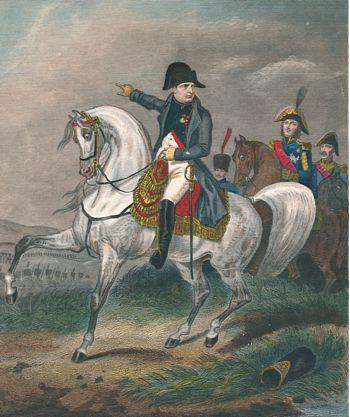
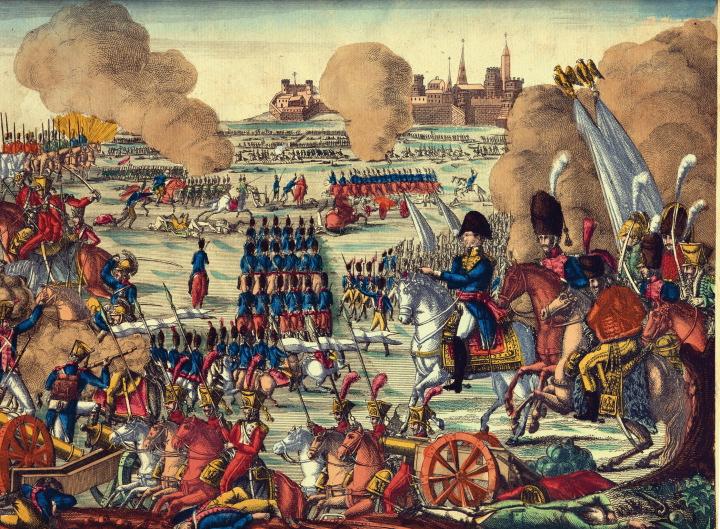
This Week in History - Napoleon launches assault on Smolensk (17 August 1812)
Napoleon launches assault on Smolensk (17 August)
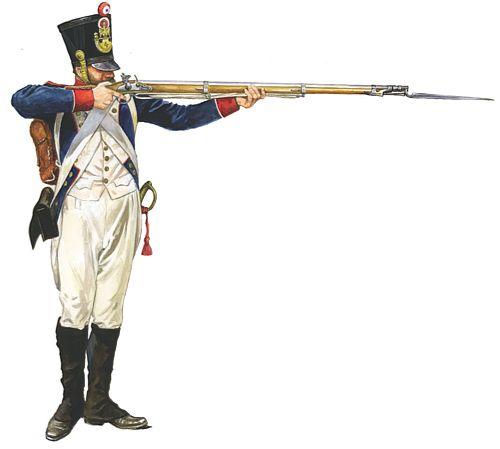
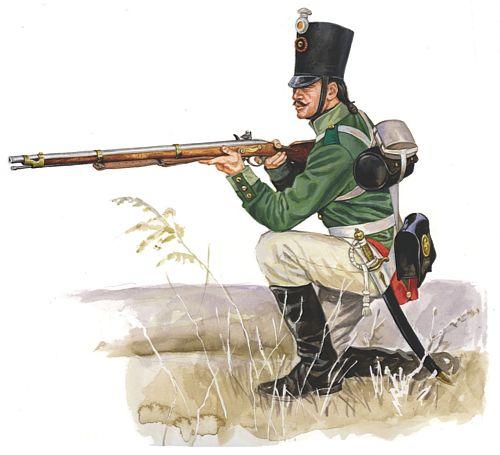
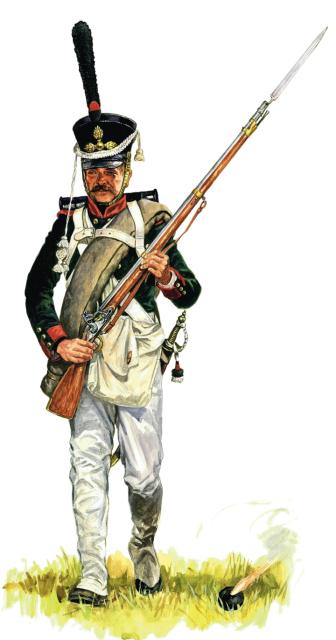
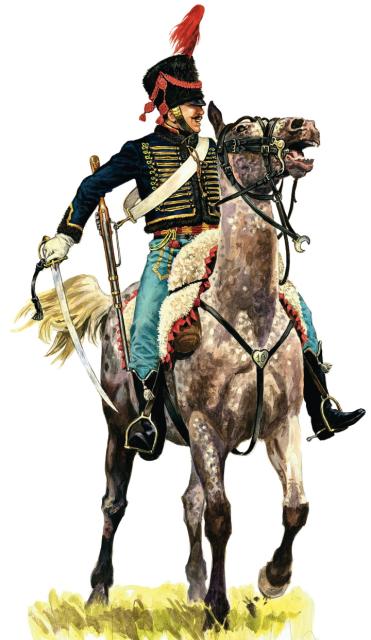
Fresh from their decisive victory at Salamanca on 22 July, Wellington and his army made a triumphal entry to Madrid. One of his soldiers recalled 'deffening shouts of; "Vivi les Angoles, Vivi les Ilandos"'. 'The inhabitants testified their Joy,' wrote Captain Bragge. However, Private William Wheeler of the 51st complained, 'But amidst all this pleasure and happiness we were obliged to submit to a custom so unenglish that I cannot but feel disgust while I am writing. It was to be kissed by the men. What made it still worse, their breath was so highly seasoned with garlick, then their huge mustaches well stiffened with sweat, dust and snuff, it was like having a hair broom pushed into ones face that had been daubed in a dirty gutter.' Wellington was admitted to the Order of the Golden Fleece, given a large estate near Granada and appointed Generalissimo. He was surrounded by women wherever he went, causing an ensign in the Coldstreams to remark: 'Lady Wellington would be jealous if she were to hear of his proceedings. I never saw him in his carriage without two or three ladies.' After this high point came the failure to capture Burgos and a tough tactical withdrawal in terrible weather to Portugal, leaving the French once again in command of Spain. However, Wellington's successes of 1812 and the drain on French resources caused by Napoleon's activities to the east enabled him to go onto the offensive the following summer with excellent prospects of final victory.
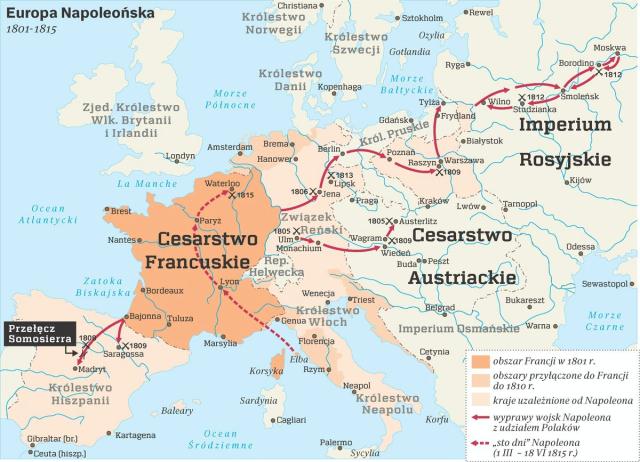
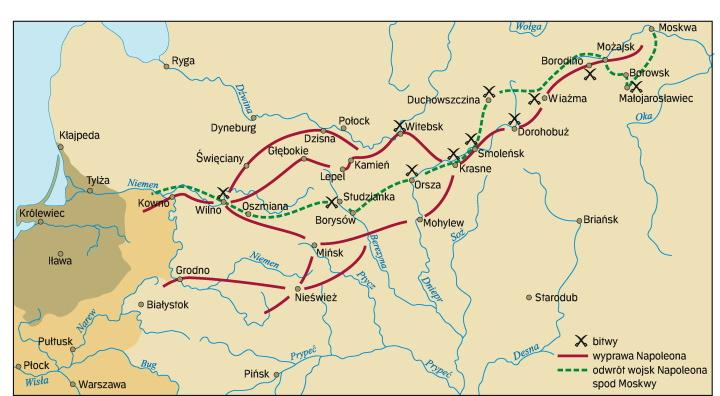
On the same day Napoleon was closing in on the city of Smolensk and on 17 August, he launched his assault on Smolensk just after midday. By 4.30pm, at the end of the afternoon's fighting, Marshall Ney had cleared the southern part of the city and was on the Dnieper. The Russians withdrew the next day but left a key ford unprotected, allowing Ney to cross and immediately harass them. On 19 August Ney engaged the Russian rearguard at Valutino. This turned into a major battle, which could have been decisive, if Junot and Murat had appreciated the opportunity to outflank Barclay, taken the initiative and fully committed their Corps. As it was, the Russians extracted themselves and fell back further east with some protection from the weather. They were to stand and fight next at Borodino on 7 September and on 14 September Napoleon had won his empty and fatal trophy, Moscow.
On the same day Napoleon was closing in on the city of Smolensk and on 17 August, he launched his assault on Smolensk just after midday. By 4.30pm, at the end of the afternoon's fighting, Marshall Ney had cleared the southern part of the city and was on the Dnieper. The Russians withdrew the next day but left a key ford unprotected, allowing Ney to cross and immediately harass them. On 19 August Ney engaged the Russian rearguard at Valutino. This turned into a major battle, which could have been decisive, if Junot and Murat had appreciated the opportunity to outflank Barclay, taken the initiative and fully committed their Corps. As it was, the Russians extracted themselves and fell back further east with some protection from the weather. They were to stand and fight next at Borodino on 7 September and on 14 September Napoleon had won his empty and fatal trophy, Moscow.
Wednesday, 6 June 2018
This Week in History - D-Day (6 June)
https://ospreypublishing.com/thisweekhistory/


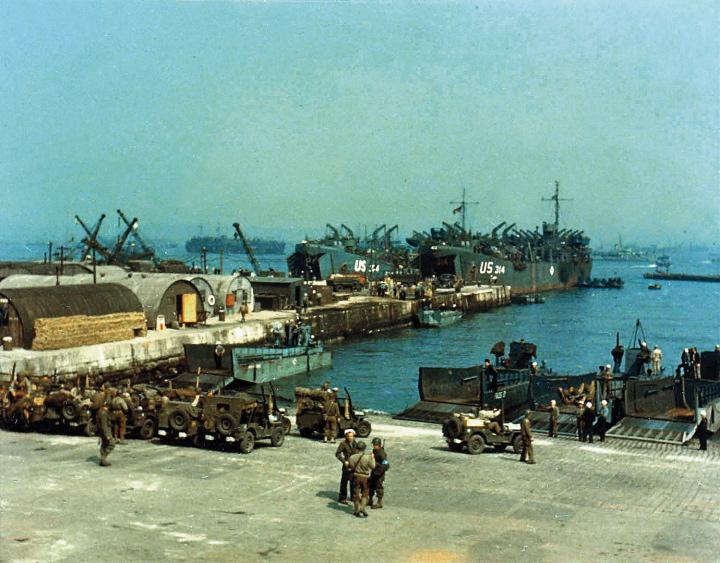
 Załadunek wojsk inwazyjnych w Wielkiej Brytanii, 4 czerwca 1944 r.
Extracts from The D-Day Companion.
The Key Role of Intelligence and Double Agents
The factor which above all else ensured both OPSEC and the success of the deception effort as a whole was intelligence. The role that intelligence played in the success of D-Day should not be underestimated, and it contributed in a number of ways. First, counter-espionage by MI5 had led to the imprisonment or turning of all of Germany’s operatives in Britain by the time of D-Day. MI5 had set up a special branch in mid-1941 to deal specifically with counter-espionage, and its efforts were made easier as the war progressed, as the various British intelligence agencies penetrated their opposite numbers in Germany and British intelligence broke German signals ciphers (particularly significant of which was the breaking of the so-called ENIGMA codes, used by the German Services). MI5 was also approached by a number of non-British nationals wishing to work for British intelligence as agents. By the beginning of 1944, MI5 had 15 double agents, and these fed carefully crafted misinformation into the German military intelligence apparatus, known as the Abwehr. The ‘Double-Cross’ agents were invaluable for reinforcing the physical deception measures. The secret of their success in the overall BODYGUARD deception can be attributed to the fact that most had been working as double agents since the early part of the war and were, therefore, trusted by their Abwehr controllers. To have double agents of such long standing was not without its dangers. In order to maintain their credibility, agents had to provide just enough information to keep them in the Germans’ employ. A certain amount of sensitive material had to be leaked to the Germans, typically information on size or disposition of forces, shipping movements, etc, which the Germans could corroborate using their own means.
Extracts from The D-Day Companion.
The Key Role of Intelligence and Double Agents
The factor which above all else ensured both OPSEC and the success of the deception effort as a whole was intelligence. The role that intelligence played in the success of D-Day should not be underestimated, and it contributed in a number of ways. First, counter-espionage by MI5 had led to the imprisonment or turning of all of Germany’s operatives in Britain by the time of D-Day. MI5 had set up a special branch in mid-1941 to deal specifically with counter-espionage, and its efforts were made easier as the war progressed, as the various British intelligence agencies penetrated their opposite numbers in Germany and British intelligence broke German signals ciphers (particularly significant of which was the breaking of the so-called ENIGMA codes, used by the German Services). MI5 was also approached by a number of non-British nationals wishing to work for British intelligence as agents. By the beginning of 1944, MI5 had 15 double agents, and these fed carefully crafted misinformation into the German military intelligence apparatus, known as the Abwehr. The ‘Double-Cross’ agents were invaluable for reinforcing the physical deception measures. The secret of their success in the overall BODYGUARD deception can be attributed to the fact that most had been working as double agents since the early part of the war and were, therefore, trusted by their Abwehr controllers. To have double agents of such long standing was not without its dangers. In order to maintain their credibility, agents had to provide just enough information to keep them in the Germans’ employ. A certain amount of sensitive material had to be leaked to the Germans, typically information on size or disposition of forces, shipping movements, etc, which the Germans could corroborate using their own means.

D-Day: June 6th 1944 as it happened
Timeline of the D-Day landings of 6th June 1944 hour by hour as events
unfolded on the day
http://www.telegraph.co.uk/history/world-war-two/10878674/D-Day-6th-June-1944-as-it-happened-live.html
Canadian soldiers land on Courseulles beach in Normandy, on June 6, 1944 as Allied forces storm the Normandy beaches. Photo: STF/AFP/Getty Images
As it happened hour by hour:
Introduction
The largest seaborne invasion in history was confirmed for June 6 1944 after
Group Captain James Stagg, chief meteorologist for the RAF, told Gen
Eisenhower, Allied Supreme Commander, that weather conditions would be
favourable. The decision was taken at Southwick House near Portsmouth,
Advance Command Post of the Supreme Headquarters Allied Expeditionary Force
(SHAEF).
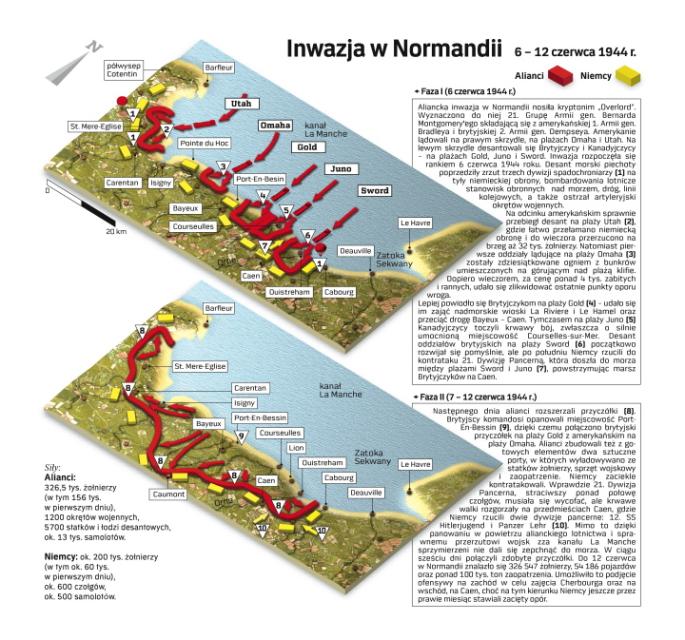
6,939 vessels – 1,213 warships, 4,126 landing craft, 736 ancillary craft and
864 merchant vessels – gathered in “Area Z” south of the Isle of Wight, in
preparation for landings at five Normandy beaches, along 50 miles of the
coast – Utah, Omaha, Gold, Juno and Sword.
Operation Fortitude, a painstaking campaign of deception involving the setting
up of a fake First US Army Group under General George Patton, has worked –
the Germans have been deceived into thinking a Normandy invasion will be
merely a diversion for a real attack at Pas-de-Calais, and that Norway will
be invaded next.
D-Day weather map / RAF Group Captain James Stagg (Geoff Robinson / PA)
of Operation Fortitude – begins, designed to distract German
anti-paratrooper units while the real landings take place.
RAF aircraft drop hundreds of dummy paratroopers across Seine-Maritime,
Calvados, Manche. An SAS team parachutes in to the Cotentin peninsula and
lands five miles west of Saint-Lô. Lieutenant Norman Poole becomes the first
man to jump over Normandy. They install amplifiers to play combat noises,
mortar explosions and the sound of soldiers cursing.
00.10 The first “pathfinders” jump over Normandy. They are in advance
of the airborne assault and will mark drop zones for paratroopers and
landing paths for gliders.
00.16 Six Horsa gliders are dropped above Cabourg. Major John Howard
commands 180 men whose objective is to capture two bridges, code-named Ham
and Jam – the Bénouville Bridge over the Caen Canal (Ham) and the Ranville
Bridge (Jam) over the river Orne. Staff Sgt Jim Wallwork pilots lead glider.
The Pont de Bénouville will later be renamed Pegasus Bridge after the emblem
of the British airborne forces, and the Pont de Ranville renamed Horsa
Bridge.
They must be captured to secure the eastward route for troops landing at Sword
beach and to prevent German tanks coming west from Calais.
Gliders landed at Pont de Bénouville (PA)
Major John Howard:
We were coming in at 90 mph on touchdown. I suppose that really was the
most exhilarating moment of my life. I could see the bridge tower 50 yards
from where I was standing. Above all, the tremendous thing there was that
there was no firing at all. We had complete surprise, we had caught old
Jerry with his pants down.
D-Day photos still haunting 74 years after invasion
http://www.marketwatch.com/story/d-day-photos-still-haunting-70-years-after-invasion-2014-06-05?siteid=rss&rss=1

On June 6, 1944, 160,000 Allied troops landed along a 50-mile stretch of heavily-fortified French coastline to fight Nazi Germany on the beaches of Normandy. Gen. Dwight D. Eisenhower called the operation a crusade in which “we will accept nothing less than full victory,” according to the U.S. Army website about D-Day. More than 5,000 ships and 13,000 aircraft supported the D-Day invasion. The cost was high — more than 9,000 allied soldiers were killed or wounded — but more than 100,000 soldiers began the march across Europe that led to the liberation of France and marked the turning point in the Western theater of World War II. Friday marks the 70th anniversary of D-Day, still one of the world's most gut-wrenching and consequential battles. At left, a Catholic chaplain conducts services on a pier for the first D-Day assault troops in Weymouth, England. See more of the extraordinary images from D-Day.

This photograph, credited to Chief Photographer’s Mate Robert F. Sargent, is titled “Into the Jaws of Death — U.S. Troops wading through water and Nazi gunfire.” It has been captioned: Landing craft from the U.S. Coast Guard-manned USS Samuel Chase disembark troops of Company E, 16th Infantry, 1st Infantry Division (the Big Red One) wading onto the Fox Green section of Omaha Beach on the morning of June 6, 1944. American soldiers encountered the newly formed German 352nd Division when landing. During the initial landing, two-thirds of Company E became casualties.
On June 6, 1944, 160,000 Allied troops landed along a 50-mile stretch of heavily-fortified French coastline to fight Nazi Germany on the beaches of Normandy. Gen. Dwight D. Eisenhower called the operation a crusade in which “we will accept nothing less than full victory,” according to the U.S. Army website about D-Day. More than 5,000 ships and 13,000 aircraft supported the D-Day invasion. The cost was high — more than 9,000 allied soldiers were killed or wounded — but more than 100,000 soldiers began the march across Europe that led to the liberation of France and marked the turning point in the Western theater of World War II. Friday marks the 70th anniversary of D-Day, still one of the world's most gut-wrenching and consequential battles. At left, a Catholic chaplain conducts services on a pier for the first D-Day assault troops in Weymouth, England. See more of the extraordinary images from D-Day.
This photograph, credited to Chief Photographer’s Mate Robert F. Sargent, is titled “Into the Jaws of Death — U.S. Troops wading through water and Nazi gunfire.” It has been captioned: Landing craft from the U.S. Coast Guard-manned USS Samuel Chase disembark troops of Company E, 16th Infantry, 1st Infantry Division (the Big Red One) wading onto the Fox Green section of Omaha Beach on the morning of June 6, 1944. American soldiers encountered the newly formed German 352nd Division when landing. During the initial landing, two-thirds of Company E became casualties.
D-Day landings: Operation Overlord in numbers
http://www.telegraph.co.uk/news/2016/06/06/d-day-landings-operation-overlord-in-numbers2/

On June 6, 1944 Allied forces invaded Normandy in Operation Overlord during World War II. The largest seaborne invasion in history, the operation began the invasion of German-occupied western Europe and contributed to an Allied victory in the war.
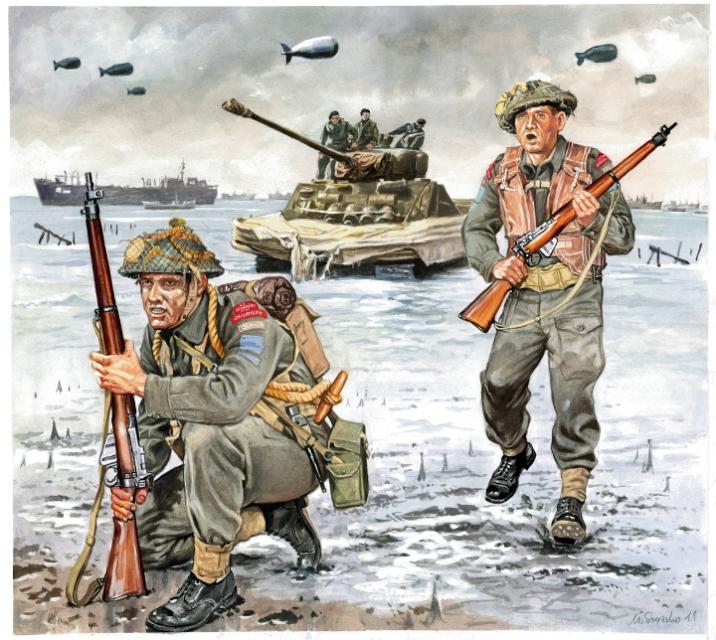
Above: British soldiers land in Normandy.

The Allied commander and US general Dwight D Eisenhower gives instructions to paratroopers June 6, 1944 in England at the beginning of D-Day landing operations in Normandy.

On D-Day, the Allies landed around 156,000 troops in Normandy. The American forces landed numbered 73,000: 23,250 on Utah Beach, 34,250 on Omaha Beach, and 15,500 airborne troops. In the British and Canadian sector, 83,115 troops were landed (61,715 of them British): 24,970 on Gold Beach, 21,400 on Juno Beach, 28,845 on Sword Beach, and 7900 airborne troops.
Above: Canadian soldiers from 9th Brigade land with their bicycles at Juno Beach in Bernieres-sur-Mer.
On June 6, 1944 Allied forces invaded Normandy in Operation Overlord during World War II. The largest seaborne invasion in history, the operation began the invasion of German-occupied western Europe and contributed to an Allied victory in the war.
Above: British soldiers land in Normandy.
The Allied commander and US general Dwight D Eisenhower gives instructions to paratroopers June 6, 1944 in England at the beginning of D-Day landing operations in Normandy.
On D-Day, the Allies landed around 156,000 troops in Normandy. The American forces landed numbered 73,000: 23,250 on Utah Beach, 34,250 on Omaha Beach, and 15,500 airborne troops. In the British and Canadian sector, 83,115 troops were landed (61,715 of them British): 24,970 on Gold Beach, 21,400 on Juno Beach, 28,845 on Sword Beach, and 7900 airborne troops.
Above: Canadian soldiers from 9th Brigade land with their bicycles at Juno Beach in Bernieres-sur-Mer.
Subscribe to:
Posts (Atom)