This bloody war started in 1954 and ultimately cost the lives of almost half a million Algerians, along with 25,000 French troops and 3,600 European settlers. Close to 1.5 million settlers also suffered exile at the end of the war, and about 100,000 Muslims were slaughtered by the FLN as revenge for perceived ‘collaboration’. The effects of the war in France were also dramatic, as the country teetered on the brink of military
coup d’etat and the Fourth Republic fell. The repercussions continued into the late twentieth century, as various fundamentalist Islamic groups clashed with the Algerian government, leading to civil war between 1991 and 2002. The following extracts from Men at Arms 312:
The Algerian War 1954–62 describe the background and harsh reality of one of the most bitter conflicts of modern times.
The Algeria of the 1950s
By the early 1950s Algeria had enjoyed for nearly a century the official status of ‘France overseas’ — a constitutional fiction to which many Frenchmen clung passionately, ostensibly justified by the parliamentary representation in Paris of her three departments (from west to east, Oran, Algiers and Constantine, popularly called the Oranais, Algerois and Constantinois). However, only a tiny minority of the Muslim population held French citizenship rights or significant property. Since the initial French landings in 1830 on a coastline under the nominal authority of the decaying Ottoman Empire, a vast, unexploited, and more or less chaotic tribal hinterland had been transformed into France’s largest colony: a source of cheap agricultural produce, and a captive market for French manufacturers.
The Muslim population had exploded to some eight million, at a time when France had a weak economy and runaway inflation. Some 75 per cent of Muslims were illiterate; they suffered chronic unemployment, poor health, and real hunger. The great majority of those who did have work were peasant farmers or urban labourers scraping a subsistence in more or less abject poverty.
Although outright banditry was far from unknown in remote areas, few Muslims were involved in politically motivated subversion. Rural villages accepted the authority of traditional community elders, whose obedience to the often distant French administration was rewarded by petty privileges. The older generation were often genuinely loyal to France, the caids (chieftains) and rural constables wearing their World War medals with pride; activists contemptuously dismissed this class as the Beni Oui-Oui, the ‘Yes-Yes Tribe’. The urban poor were more restive; trade unions provided some focus of discontent, although the Communist Party was never strong. However, pressure for Muslim rights — either internal self-government, independence, or even complete integration with France — had long been building up among the small but significant academic and professional class which had benefited from French education.
Although the strains had become more mixed in the towns, an age-old suspicion persisted between the highland Berbers of the Aurès and Kabylia and the lowland Arabs. The Berbers were the poorer and more warlike of the two communities; but Algerians in general have been characterized by their own writers as tough, stoic, proud, stubborn, secretive, violently quarrelsome, and unforgiving — ‘a people of right-angles, without curves’.
They were also given to extreme physical cruelty. Torture was commonplace; the knife — to cut throats, and to inflict appalling mutilations as a warning to others — was the weapon of choice (throat-cutting is associated with sheep-killing, and is thus a deliberately insulting death). Throughout the war many more Muslims died at the hands of their fellow Algerians than of the French.
The great majority of productive land, commerce and industry, and virtually all political and administrative power lay with the long-established 1.2 million-strong European settler community (known as colons or pieds noirs), mainly of Spanish, Italian, Corsican and Alsatian stock. Apart from a small liberal intelligentsia the colons were politically and racially conservative, their attitudes to the Muslims ranging from paternalism to callous bigotry. Although there were many colons and Muslims whose shared love for their often stunningly beautiful country brought them together in friendship, the twin walls of religion and racial injustice would always ultimately separate them.
Representative Action, Airborne Troops
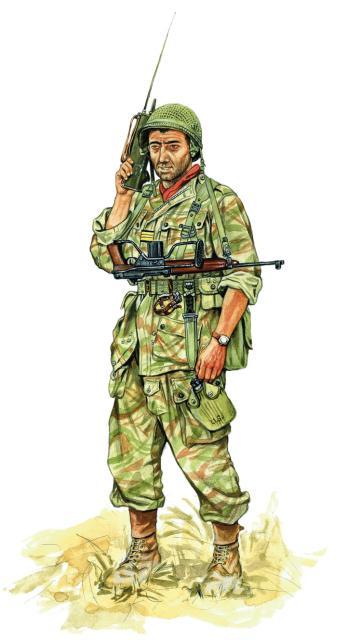
An early benchmark for the tactical use of helicopter lifts was the fight between ALN [Army of National Liberation] Cdo.41 (‘Ali Khodja’) and the 3e RPC on 23-25 May 1957 near Agounenda, in the foothills fringing the great agricultural plain of the Mitidja south of the capital. In early May Cdo.41 had routed a Spahi unit, killing 60 for the loss of only seven; a fortnight later they ambushed the 5e BTA, killing a captain and 15 men and persuading others to defect. Intelligence suggested that Cdo.41 would now head west, escorting Wilaya 4 commanders to a rendezvous with other forces near Médéa; and Lt.Col. Bigeard picked Agounenda on the Oued Boulbane, a known ALN route, for an ambush. Trucked from their base at Sidi-Ferruch to Hill 895 by 0130hrs on 23 May, Bigeard’s 700 paras made a cold, four-hour night approach march over rough terrain under strict noise and light discipline. Before dawn they were in place and concealed. The HQ and mortars were on Hill 1298; the 1st, 2nd and 3rd Cos. and the Recce Sqn. (on foot) were spread over 10km on four crests overlooking the enemy’s probable route; the 4th and Support Cos. were in reserve, and helicopters and ground-attack aircraft were on stand-by at Médéa.
At 1030hrs the most northerly and exposed company (3rd, ‘Blue’, under Capt. Llamby) radioed sighting a large ALN force approaching his position above the north bank of the Oued Boulbane from the east; at 1045 he opened fire. Already warned by a shepherd, Si Azzedine — leading a column of at least three companies — was attempting to outflank the paras from the north. Llamby, his 100 men outnumbered three to one, came under fierce pressure. The helicopters were already on their way; Bigeard immediately ordered the Support Co. lifted onto high ground north of 3rd Company. The first sticks jumped from the doors at 1055; the whole company was in action by 1130. While the 1st and 2nd Cos. force-marched across country to the support of the 3rd, the Sikorskys lifted the unengaged Recce Sqn. and 4th Co. slightly north-east of Llamby’s battle.
Unaccountably, the ALN took to the low-lying Oued Boulbane, dominated from higher ground by the paras — 3rd, 4th, Support and Recce north of it, and 1st, 2nd and HQ to the south. In a series of running battles over some 30 square kilometres, which lasted 48 hours, Cdo. 41 and at least two other katibas made several vigorous counterattacks which came to hand-to-hand fighting. Despite the support of tactical aircraft the paras were too thinly stretched to maintain a tight cordon, however, and some 200 ALN eventually managed to slip away. They left 96 dead and a dozen prisoners, but carried off all but 45 weapons and most of their wounded; the paras lost 8 dead and 29 wounded.
If the French were encouraged by the success of battlefield air portability, the ALN took from Agounenda the lesson that large-scale confrontations in the heart of the countryside must be avoided at all costs. Even when they did occur, however, the paras did not always pay such a low price for victory. For instance, during the ‘Battle of Souk-Ahras’ just inside the Morice Line on 29 April 1958, the 3e Cie./9e RCP, air-lifted onto the Djebel Mouadjene, was surrounded by superior numbers in thick brush which hampered air support, and suffered nearly 30% dead and 30% wounded.
Further readingMen at Arms 325:
French Foreign Legion 1914–45 describes the uniforms, equipment and history of these elite troops during the two World Wars, illustrated with rare contemporary photographs and full-colour artwork.
Men at Arms 322:
The French Indochina War 1946–54 is a detailed examination of French troops in the first of their colonial struggles of the later twentieth century.
Elite 6:
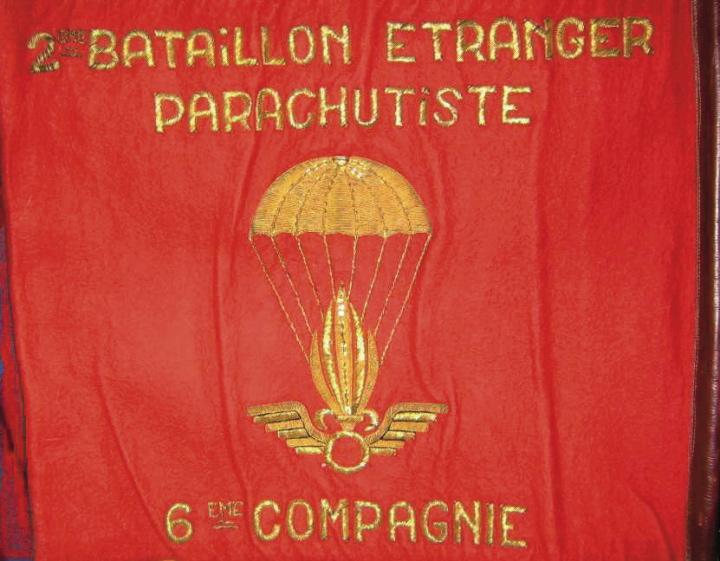
French Foreign Legion Paratroops tells the story of the creation of the famous paratroops who were to play such a key role in the Algerian War.