Friday, 10 August 2018

Reginald ‘Titch’ Snowling - obituary

Gunner who was probably the shortest man to land on the D-Day beaches and later blew up two German tanks with one shell

Reginald ‘Titch’ Snowling with his medal last year
At 4ft 11in tall, Reginald “Titch” Snowling was almost certainly the smallest soldier to land with British forces in Normandy on D-Day, June 6, 1944, and was also unique in knocking out two German Panther tanks with a single shot.
Afterwards Snowling said: “The tanks just blew up. When our Rifle Brigade went up in their half-tracks to have a look, there was nobody left alive. The officer in charge came back and asked, ‘Who fired that shot?’ And when told it was me said, ‘Make sure he gets a Military Medal.’ But I never got one.”

100 Years Ago

A brilliant success

Troubles are multiplying for the Germans. Today, with French cooperation, we launched the first offensive on a large scale this year, recalling the great attacks of the Somme, the battle of Arras, or that of Flanders. It was admirable in its organization and execution, taking the enemy completely by surprise.
The attack was made by the Fourth Army, under the command of General Sir Henry Rawlinson, in conjunction with French troops, both being under command of the British Field Marshal Commanding-in-Chief. The front of attack was about 15 miles, of which British troops had charge of the northern 12 miles from near Mericourt to a point south of the River Luce and the Amiens-Roye road below Hangard, while the French extended the attack for another three miles to and across the River Avre. The time chosen was half-past 4 this morning.
It was an anxious night, for we had no idea whether the Germans had any warning of our plans. They took some prisoners in the fighting below Morlancourt two days ago, and it was possible that these men might have given some information away. From prisoners, indeed, we gathered that the Germans anticipated some sort of local operation hereabouts some time soon, but they had no inkling that the blow was to come so quickly, or that it was to be of anything like the shattering force with which it was delivered. The night passed well, therefore, and when the critical moment came there was no sign of apprehension on the enemy’s part. Then, out of the silence, it sounded to onlookers as if our barrage was as splendid and as heavy as any that the war has known. It lasted only for a few minutes before the attack started, but those few minutes were enough to flatten the enemy defences and to leave him stunned and naked. Our men as they went forward all seem to have had the same impression of the enemy being completely smothered, so that only scattered machine-guns here and there opposed our advance in the frontline positions, and these were easily accounted for either by Tanks or infantry with the help of smoke screens. Tanks joined in the attack everywhere, and did magnificent service. In little more than two hours we had heard of the capture of the whole tier of nearer villages.

The new allied offensive

The new Franco-British offensive under the command of Sir Douglas Haig on the Allied front before Amiens is one of the greatest and most gratifying surprises of the war. It surprised the British public just as much as the enemy for, with the exceptions of the battles of Messines and Cambrai, never has a secret been better kept. Most people have been speculating about the possibility of an early German attack in the neighbourhood of the Lys, and the whole country hailed with deep delight the news that on Thursday the British Fourth Army and the French First Army had struck swiftly and deeply astride the Somme, and between the Somme and the Avre.
From the outset the attack went forward at unusual speed. The new “whippet” tanks and squadrons of armoured cars greatly assisted the infantry in their rapid advance. No offensive in which the British Army has participated has made so much progress on the opening day. By nightfall Amiens was free from the danger of any recurrence of the bombardment which has wrought so much destruction. The advance of the French on the right has freed the main railway line to Paris from menace, and yesterday trains were once more running from Amiens to St Just. All the testimony tends to show that the rout of the Germans was complete, at any rate in the broad centre of the attack. By noon yesterday the count of prisoners had reached 17,000, 4,000 taken by the French and 13,000 by the British. The number of guns captured is estimated at between two and three hundred. This battle differs from any in which we have engaged, for tanks and cars, and even cavalry, are operating considerably in advance of the main fighting line. We know that the Germans have suffered one of the worst reverses since the war began. The prospects of effective retaliation on a great scale in the West this autumn are diminishing. For the moment the initiative has clearly passed to the Allies. The plans of Hindenburg and Ludendorff are more deranged than ever, and the outlook for the Allies was never more promising. We may add that though our total casualties are said to be light, last night’s aviation report showed that losses among our gallant young airmen are exceptionally heavy. Fifty of our machines are reported as “missing”.

Thursday, 9 August 2018

The Times History of the War - The Battles of Amiens and Bapaume, August 1918

The Battles of Amiens and Bapaume, August 1918
This week's chapter examines the Battle of Amiens resumed, work of the cavalry and tanks, defensive tactics, Ludendorff's order, Humbert's attack towards Lassigny, Allies reach the line of 1917, King's visit to the Front, German damage to Amiens, Lassigny captured, enemy withdrawal on the Ancre, German comment on the fighting, British dispositions, opening of the Battle of Bapaume, progress of the attack, work in the air, fall of Albert, Thiepval ridge carried, air fighting in August.
At one point the French had some difficulty with a village which was heavily defended with machine-guns, many of which were in the upper stories, which held them up for a time. Five of the heavy tanks were brought up and proceeded to demolish the houses from which the fire came. In this way 10 houses were dealt with in succession

Wednesday, 8 August 2018

Jack Tredrea obituary

Commando who led a platoon of headhunters in Borneo, but did not get the message that the war had ended in August 1945

Jack Tredrea was part of the elite Z Special unit during the Second World War
Emperor Hirohito had announced Japan’s surrender in mid-August 1945 and the Second World War was officially finished, but no one had told an Australian commando who was leading a platoon of headhunters against Japanese forces in the Borneo jungle.
Warrant Officer II Jack Tredrea fought on, continuing to harass and ambush the enemy with rifle fire, grenades, parangs and a silent assault by poison dart propelled from a blowpipe.

Zhao Kangmin obituary

Single-minded museum curator who discovered the ancient Terracotta Army in 1974 after farmers had unearthed shards of pottery

The Queen viewed the Terracotta Army in 1986
As he gathered up the terracotta heads, torsos and arms half-buried in the soil, Zhao Kangmin knew that he had made one of the greatest archaeological discoveries in the world — an ancient terracotta army designed never to be seen by the living.
He wrapped the earthen limbs in linen and took them back to the small government museum where he worked as a curator. He then laboured through the night, washing the shards and using glue and plaster to piece them back together. Some fragments were no bigger than his thumbnail. A man of strict discipline and few words, Zhao was devoted to archaeology and nothing if not patient. When he had finished, two giant terracotta warriors towered over him.
What he had identified that day in 1974 was a vast terracotta army, commissioned about 2,000 years ago by China’s first emperor, Qin Shi Huang, to guard his tomb in the afterlife. As official excavations began around the ancient capital, Xianyang, about 22 miles from present-day Xi’an, the capital of Shaanxi province, archaeologists soon found that there were thousands of figures. Among them were infantrymen, officers and kneeling archers, each with different facial expressions and positioned according to rank, as well as clay chariots with horses. The army occupied a series of underground burial chambers nearly 200 times bigger than the Valley of the Kings in Egypt; one chamber was the size of an aircraft hangar.

100 Years Ago


Forward with the Americans


New murder traps have been set by the Germans to catch unwary Americans in the towns and cities from which the enemy has been driven. On the floors in houses were found glass bulbs or bladders, full of phosgene gas to poison our men when entering. Other deposits of the same gas were left in tiny bags under helmets, as the Germans know that souvenir collecting is a passion of Americans. The captain who led the advance patrol of 30 Americans into a captured town saw in the dining-room of a small hotel a loaf of bread on the table, with a knife sticking in it. Suspecting a snare, he called upon a German prisoner to withdraw the knife. The effect was a violent explosion. A bomb had been left in the loaf, but only the prisoner was injured. When the captain reached the hotel a German officer came out, speaking excellent English, saying he desired to surrender. The American pulled out his revolver and jumped back barely in time to escape a rain of bullets from a machine-gun hidden under a cellar door.
Machine-guns, which have practically supplanted rifles with the Germans, are the bane of the overseas soldier, yet the Americans throw themselves against the pernicious weapons with almost superhuman audacity. Set up in rocky nests, clumps of bushes, or along ridges commanding fields of uncut grain, they are handled by an experienced enemy who keeps his presence of mind and offers the most desperate resistance before his opponents can come to hand-to-hand conflicts, where the superiority of the fresh and well-fed American troops always manifests itself
In the operating room of a hospital left by the enemy were some rolls of crepe paper, which the Germans have been using for dressing wounds, showing they have little cloth left. We also discovered that some burned bits of harness, instead of leather, were made from composite paper and hemp. A number of motor-cars burned and abandoned by the Germans in their flight had iron tires, indicating that the enemy was out of rubber. Millions of dollars’ worth of German supplies have been destroyed by the retreating enemy. The horizon at night is a succession of gigantic red patches, with occasional roars of touched-off ammunition which they could not remove.

Tuesday, 7 August 2018

This Week in History - The Armada Campaign (8 August 1588)

https://ospreypublishing.com/thisweekhistory/


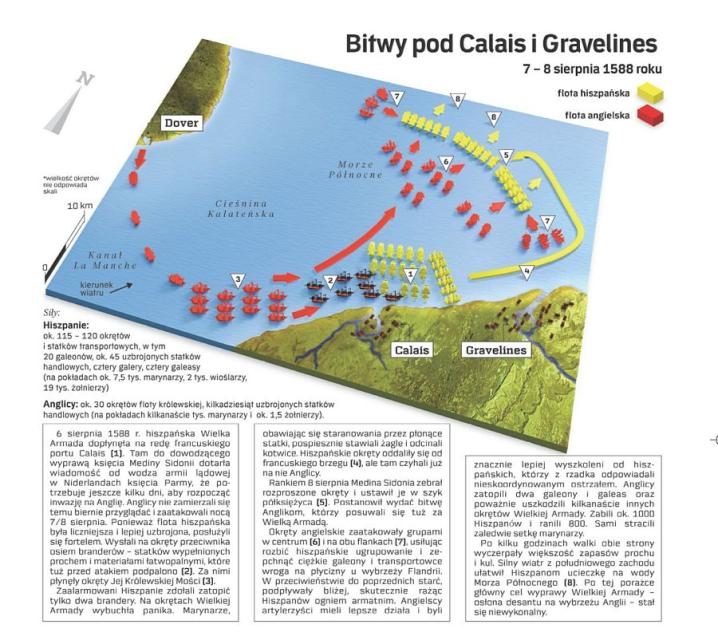
Early on 8 August, Lord Howard's fireship attack drove the Spanish Armada from its anchorage off Calais. Most ships had to abandon their best and heaviest anchors as they manoeuvred rapidly to escape the threat and so were unable to return to the French coast where it had been planned that the Duke of Parma's invasion force would board. The Spanish were now widely scattered with the English fleet poised to windward and about to engage for the final, decisive battle of Gravelines. Superior English gunnery and a change in the wind ultimately overcame determined resistance and the Armada was driven up into the North Sea to sail home round Scotland. It was still intact as a fleet and a threat for the future, but in September Atlantic storms sweeping onto the west coast of Ireland destroyed around 45 of the 110 ships that had set sail from Lisbon five months earlier. Philip II did plan a second attempt to invade England with a new Armada, but, in 1596 and 1597, bad weather again defeated him and preserved the Reformation.

Further reading

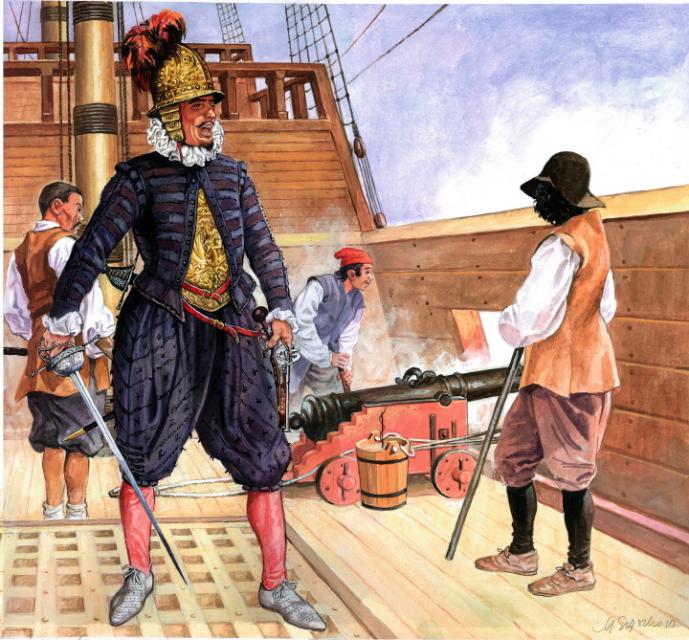
Campaign 86: The Armada Campaign 1588 The Great Enterprise against England (see extract) is a detailed and gripping account of the 10 days of action between the first sighting of the Armada off the Devon coast and the battle at Gravelines and also covers the build-up to the invasion and the aftermath of its failure, all in the context of the national and religious politics of the time, and naval technology, tactics and strategy. Elite 15: The Armada Campaign 1588 focuses on the organisation, troops and equipment of the opposing sides while Elite 70:Elizabethan Sea Dogs 1560-1605 (extract below) goes into more detail on the swashbuckling English sea captains of the era, notably Drake, Grenville, Hawkins and Frobisher who were all involved in the action against the Armada. It also includes background on the Elizabethan art of war and on the ships that defeated the Armada.