Showing posts with label Австралія. Show all posts

Wednesday, 25 April 2018

This Week in History - ANZAC Day (24 - 30 April)

https://ospreypublishing.com/thisweekhistory/


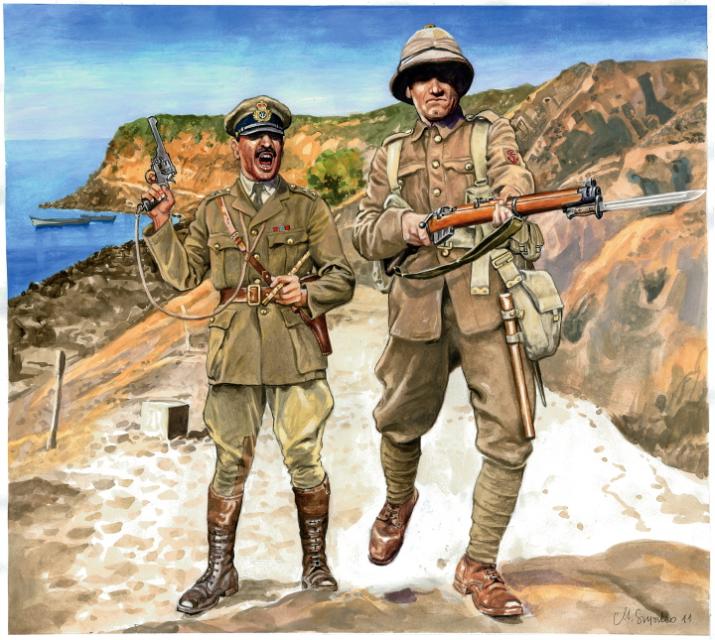
Oficer Dywizji Morskiej uzbrojony w rewolwer Webley Mk.VI oraz żołnierz z karabinem Lee-Enfield Mk.III


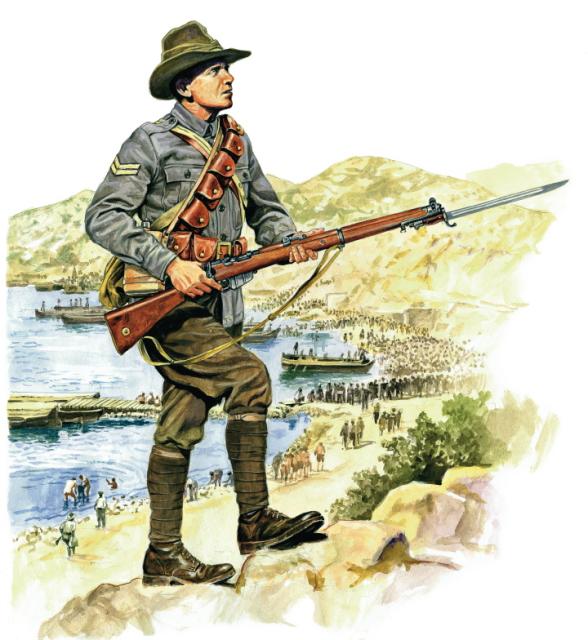
Piechur australijski z karabinem Lee Enfield SMLE Mk III
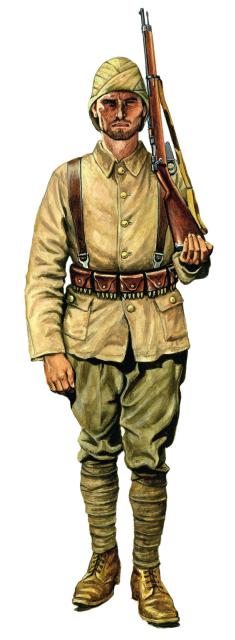
Żołnierz piechoty tureckiej uzbrojony w karabin Mauser wz. 1890

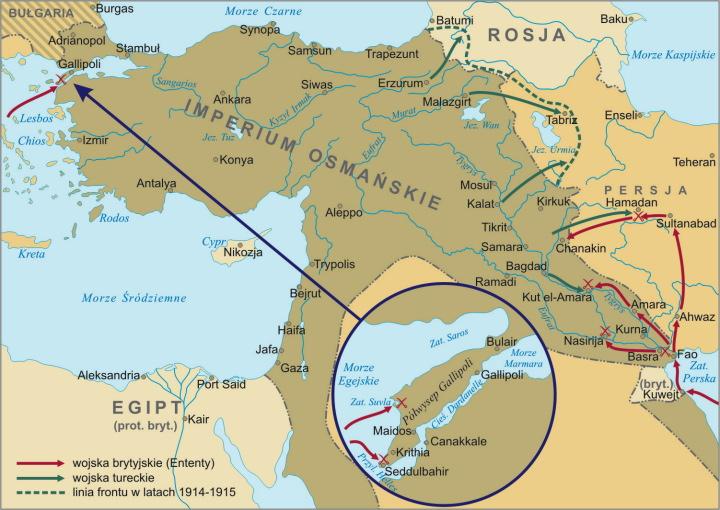
In the autumn of 1914, the Allies realised that Turkey, crucial because of its control over routes of contact between Russia and the Allies in the west, was not going to remain neutral as had been hoped, and action would have to be taken.

Two days before the outbreak of war, Germany and Turkey had agreed on an alliance against Russia, although this did not commit Turkey to military action. Events in the next few months, however, including the British requisitioning of two battleships built for the Turkish Navy in Britain, meant that the entry of Turkey into the war seemed increasingly likely. By September 1914, German command had been extended to the Turkish Navy, and the Bosphorus waterway had been closed in contravention of international law. Turkey was now firmly in the German camp. Following an ultimatum to the Turkish government, hostilities officially began on 31 October 1914. By early 1915, it was obvious that the war would be protracted, and that Russia was stretched fighting on two fronts. Into this context was born the plan to attack the Dardanelles.

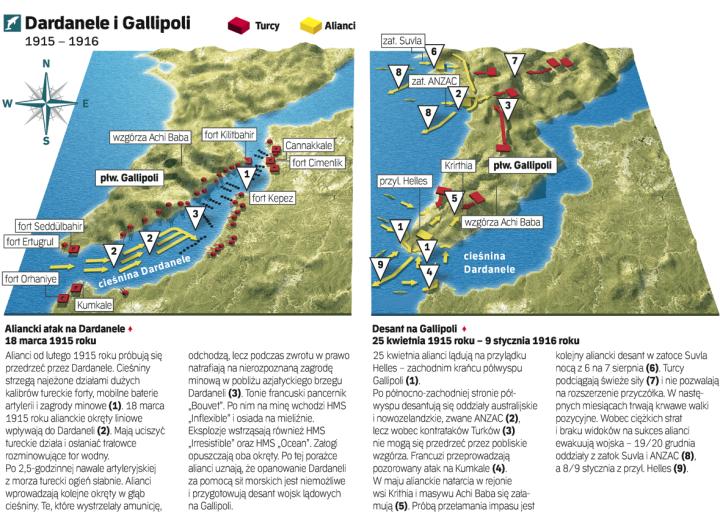
Simply, the original plan was the forcing of the Dardanelles by a squadron of battleships, which were considered expendable. This would open the waterway for Russian ships and hopefully cause the downfall of the Turkish government. This would be followed by landings on the peninsulas. Plans developed, and a large number of powerful ships, with a force of British, French, Australian and New Zealander divisions (ANZAC forces), were allocated for the campaign.
Monday, 16 April 2018

100 Years Ago - German Offensive


https://www.thetimes.co.uk/edition/register/general-foch-and-thebattle-p5d9zbw8r


APRIL 16, 1918

General Foch and the Battle

The British and French governments have now agreed to confer upon General Foch the title and powers of Commander-in-Chief of the Allied Armies in France. The decision was clearly not premeditated, but has been rendered imperative by the military position in France and Flanders. Until recently the French and British Armies fought, for all practical purposes, in watertight compartments. The point of contact between the two Allied Armies remained clearly marked until the Germans began their great offensive between Arras and La Fère on March 21. In consequence of the retirement of our Fifth Army, and the hasty concentration of French reinforcements, units of both forces found themselves temporarily intermingled. The French were gradually taking over part of our battle line, and very soon were holding about half the battle front. The battle, in short, was at first exclusively British, but it became half French. In these circumstances the compromise adopted by the Supreme War Council at Versailles last winter was rapidly extended, and General Foch, at the joint desire of the British, French and United States Governments, undertook the task of co-ordinating the action of the Allied Armies with the supreme direction of strategy. This arrangement was hardly in working order when fresh complications arose as a consequence of the new offensive initiated by the enemy north and south of Armentières last week. Pressed by superior forces, the British line astride the Lys was slowly withdrawn for a considerable distance, and our Army again became in need of French help. The advent of French units in the northern battle signifies that, for a period the end of which cannot be foreseen, the old conditions under which the French and British Armies fought on separate fronts are over. There has been a fusion of resources, further emphasized by the decision of the United States government to merge many of their available battalions in French and British brigades to complete their training.
The step does not deprive the British Commander-in-Chief of any of his direct authority over the British Army, and we believe that the British peoples will fully share the entire confidence reposed in General Foch by his own countrymen.

Thursday, 30 November 2017

100 Years Ago - Russia, France, Palestine


Hindenburg main trenches

The main trench of the advanced line of the Hindenburg system was deep, narrow, very cleanly cut, and well built, with numbers of strong points, snipers’ posts, and so forth, but apparently without dug-outs. The main trench of the second line, 500 to 1,000 yards behind, is of immense width, 16ft in most places, presumably for the purpose of checking the Tanks. Both at the front and rear the trench descends perpendicularly some five feet to a broad bench or fire step, which is four or five feet above the level of the trench bottom. At places there are trench-mortar positions, where the trench widens out into a great chamber of some 30 by 40ft. Everything is on the same colossal scale. The third main trench is built on a similar plan. Besides these the whole area, to a depth from one and a half to two miles, is intersected with support and communication trenches, besides barbed wire in quantities almost incredible. The dugouts indicated that they were meant to be held by a considerable permanent garrison. Everywhere there are signs of this expectation of permanent possession, and of the suddenness of the evacuation.
The barbed wire entanglements were of extraordinary strength, not merely in depth and complication, but also in the character of the individual strands, some of which were so thick as to be very difficult to cut with hand nippers, and so densely set with barbs over an inch in length as to be almost impossible to take hold of. Barbs like great acacia thorns were so close together as to be almost continuous, and there was not even room to grasp the wire with the thumb and finger. Before the great main line, a deep belt of this wire was set well forward, some 50 yards from the trench, then between it and the trench a further deep belt, broken into islands and built in cunning patterns, with openings through which the defenders could sally. When the attackers penetrated the front belt they would be herded to the openings, which, of course, were swept by machine-guns.
The amount of labour expended on the Hindenburg defences is simply tremendous and most craftily planned. That we should have broken through with the suddenness we did will remain one of the most extraordinary feats of this war.

Thursday, 11 May 2017

100 Years Ago

http://chestnut-ah.blogspot.com/2017/05/100-years-ago-greecesalonika.html


Australians’ refusal to retire

The Australians by midday held a solid section of the Hindenburg line. The Germans attacked heavily at night and the fight surged back and forward. Yesterday they pounded the position with heavy guns, and part of it was lost for a time. But to the present moment our men are still holding almost exactly the line which they were asked to take.
The struggle was a wild one. At noon on the first day the heads of Germans were seen at various points, and presently on they came, out of the sunken road which our troops had occupied earlier, diving from shell-hole to shell-hole, two or three hundred of them together, for all the world like a school of seals. It is some new method of attack, and it was well carried out, but they say it was irresistibly funny to watch. It was wiped out by our machine-guns and rifles. The men stood breast high over the parapet, with cigarettes in their mouths and shot as they have seldom had the chance to shoot. A few brave men got within a dozen yards of them in one part. A bombing attack down the trench was made at the same time. It met with a shower of trench mortar bombs. One German was hoisted bodily 30ft into the air, turning over and over as he spun. The attack melted.
The German trench mortars kept up a most powerful bombardment, and under it the right half of the attack was gradually forced back. A Western Australian unit bombed back along the trench to the limit of the objective, and again it was driven back. At 10 o’clock at night the Germans counter-attacked again furiously down the trench. We were holding barely 500 yards of the Hindenburg line by this time.
When things seemed past praying for, the word to retire came along part of the line. The men whom it reached flung it back. “Who said so” they asked. “What officer gave that order?” The officers and men had determined that, if it came to the worst and the Germans closed entirely round them, they would cut their way back through the enemy. But it never came to that. The following afternoon the New South Welshmen bombed their way a full 600 yards up the lost ground. Though with Germans on three sides of them and counter-attacked day and night, the Australians still hold a position not paralleled in the history of this or of any other war.


Tuesday, 31 January 2017

100 Years Ago - the Great War and Votes for Women


votes.jpg


http://www.thetimes.co.uk/past-six-days/2017-01-28/register/famine-with-plenty-in-russia-kmphx76xk


Famine with plenty in Russia


Russia is experiencing famine in the midst of plenty. The scarcity of food is the one thing talked of throughout the land. Last summer the poorer people took up their positions outside the Petrograd municipal meat shops at 10 o’clock in the evening. The sun had hardly set over the Elagin Island, where fashion and wealth enjoyed their ease and the wonders of the white nights, before the poor, basket in hand, began their weary vigil. Some waited 10 and 12 hours for a morsel of meat. Since then we have seen queues become the rule — for meat, for bread, for milk, for vegetables, for sugar, people wait in long “tails”. Rich and poor participate, the latter in person, the former by proxy through their servants. With the thermometer sometimes at 20 below zero Fahrenheit, people have to wait hours outside each shop to get daily necessities. The writer of this article saw a “tail” of more than 1,200 people outside the cooperative shop for railway employees at Kosloff waiting for white flour. Kosloff had then been without flour for 10 days, though half a dozen of the largest flour-mills in Russia are within a 250-mile radius of the town.


Probably there is sufficient food in the country to feed the population for the next two years. The problem to solve is how to distribute it. The Department of Provisions has borne the burden of supplying the Armies in the field since July, 1915. As time went on the deficiency in provisioning the civil population increased. The Ministry of Trade and Industry considered the question and appointed committees, but there the matter rested. Now its efforts have completely ceased.


Throughout the war the railways have supplied the Army with all that is needed or was available. This shows some organization; but it was done at the expense of starving traffic to the capitals and large provincial towns. With thorough, or even partially, efficient organization the great towns and manufacturing centres could have been supplied with all necessities in sufficient quantities if ordinary care had been taken in the use of goods trucks. Organization and co-ordination are, however, essential if Russia is to cope with her food problem; and it is for this reason that the absence of a strong, capable, and united Ministry has been felt during the past year.