Showing posts with label Ірландія. Show all posts

Thursday, 19 July 2018

British politics, 1917-1918

British politics, 1917-1918
This week's chapter examines Mr Lloyd George's government, the War Cabinet, electoral reform, the Irish Convention, the Dardanelles and Mesopotamia commissions, the India cotton duties, Indian constitutional reforms, the Corn Production Act, the Stockholm conference, the Lansdowne letter, war aims, unity of command, the "sniping" debates, the last Military Service Act, the Irish conscription clause, the Maurice letter and debate, the Education Act, the biggest Budget, the general election, the reconstructed government
It took a long time for British politicians to recognize that strategic unity was a fundamental condition of victory, and the controversy which raged around the question in the latter part of 1917 and the first months of 1918 gave rise to a remarkable series of discussions in the House of Commons which came to be known as "sniping" debates


Lords vote for woman suffrage
january 11, 1918
Lord Curzon wound up the debate with a tremendous onslaught on the principle of woman suffrage. He described the proposed change as vast, incalculable, and catastrophic, without precedent in history and without justification in experience
https://www.thetimes.co.uk/article/lords-vote-for-woman-suffrage-dfh8qrbpz?utm_source=newsletter&utm_campaign=newsletter_118&utm_medium=email&utm_content=118_18.07.2018%20Politics%20(1)&CMP=TNLEmail_118918_3777337_118

From The Times, January 10, 1918

The House of Lords tonight rejected Lord Loreburn’s amendment to the Reform Bill opening the Parliamentary franchise to women by 134 votes to 71 — a majority of 63. The debate attracted the largest House since the beginning of the war. There were more women than men in the seats allotted to the public, and there has not been such a large attendance of peeresses in the side galleries since the far-off days of party conflict.
The Lord Chancellor, in resuming the debate, said what made him anxious was the possible effect of enfranchising 6,000,000 women for a General Election during the war. There would be a mass of women without political experience upon which pacifists might work.
Lord Selborne followed. The cost of carrying the amendment would involve the rejection of the Bill and, in the climax of the war, would split the nation from top to bottom. In the whole of his political experience no measure had been stamped with such unanimous national approval. He regretted the suggestion of the Lord Chancellor that women would be likely to be a prey to pacifists.
The Archbishop of Canterbury strongly supported the women’s claim. He did not base his case on rewarding women for having done well in the war. It was rather a recognition of the part that women were now taking in our national life. Lord Lytton asked bluntly whether women were to be told again that they must remain in the same category as lunatics and children.
Lord Curzon wound up the debate with a tremendous onslaught on the principle of woman suffrage. He described the proposed change as vast, incalculable, and catastrophic, without precedent in history and without justification in experience. He even ventured on a prediction that before many years were past the influence of women voters would not be Conservative but Socialistic, to the disturbance of home life. He could not conceal that to cut the clause out of the Bill would be a challenge to the House of Commons, and that the House of Lords was not likely to prevail. In these circumstances he proposed to abstain. The division was then taken, and the announcement of the figures was received with a round of cheering — an unusual manifestation in the House of Lords. 

Thursday, 28 June 2018

100 Years Ago

https://www.thetimes.co.uk/edition/register/the-need-of-men-svjtdj3jn

The need of men

The Prime Minister intervened in a debate on the medical examination of the older recruits in the House of Commons tonight with an important statement on the need for men. After reminding members that the emergency was overwhelming, the Prime Minister declared that the comb-out in this country was not comparable with that in Germany or in France. It was true that the Americans were coming, and were prepared to be brigaded with our divisions. But, he explained, that was on the understanding that, when the new comb-out materialized, the men who came in would take the places of the Americans, so that they could form their own divisions.
Sir Auckland Geddes opened the debate. After reminding the house of the Prime Minister’s statement that it was proposed to post 7 per cent of the older men this year, he announced that so far 11.2 per cent had been medically examined, and less than one-third of 1 per cent had actually been posted. Turning to the comb-out of the younger men, he explained that for every man of the new age period who had actually joined the forces, approximately 30 young men had been combed out.
Sir Donald Maclean told him that he was still very nervous about the older men. He demanded that they should have at least as favourable a medical examination as men of lower age, and contended that there had recently been a change in the standard. He suggested that an equitable arrangement could be made if the Minister would meet the seven chairmen of tribunals who were members of the House.
The Prime Minister accepted Sir Donald Maclean’s suggestion on behalf of Sir Auckland Geddes. He gave an assurance that the War Office would use the older men, not for the fighting line, but for services behind the line and in this country. But he pointed out that their use in this way would enable the military authorities to comb out men who were fit for the fighting line, and so increase the combatant strength of the Army. As for the younger men, objections did not come from those combed out, but from the industries employing them. He appealed to the industries to remember how serious the emergency was. He said that about 6,000,000 men had already been taken out of civil life, including those who had volunteered. 

Thursday, 21 June 2018

100 Years Ago - Piave battles


Home rule and conscription

In the House of Lords tonight Lord Curzon indicated an important development in the Irish policy of the Government. He declared that in present circumstances it was out of the question to proceed with a Home Rule Bill which there was not a ghost of a chance of anyone accepting. If they could not have Home Rule, he added, they could not have conscription. The debate attracted a large attendance of peers, and several peeresses occupied seats in the side galleries. Mr Shortt, the Chief Secretary, and Sir Horace Plunkett, the Chairman of the Convention, listened from the steps of the Throne. Lord Londonderry opened by drawing attention to the inconsistencies of the Government, which cajoled Ireland at one moment and dragooned her the next. Lord Wimborne, Lord French’s predecessor as Lord Lieutenant, severely criticised ministers and suggested that conscription was now a physical impossibility. Lord Midleton urged the Government not to make the position more difficult by attempting to drive a Home Rule Bill through during the war.
Lord Curzon, replying, narrated the circumstances which had led the Government earlier in the year to adopt the separate policies of conscription and Home Rule for Ireland, and went on to the discovery in May of a formidable conspiracy of the leaders of the Sinn Fein movement with the enemy of this country. He explained how those revelations had occasioned in the Cabinet surprise and consternation. This new situation was accentuated by the fact that the attitude of every section of opinion about Home Rule had changed. His conclusion was that to proceed with the preparation of a Home Rule Bill and its introduction into Parliament would be a folly and almost amount to a crime. It was necessary in respect both to conscription and Home Rule not to abandon their policy or to change their front, but to recognize the facts and adjust their policy to them. Turning to Lord French’s appeal for voluntary recruits, Lord Curzon said that he would be surprised if the clergy did not come out on the side of this country in its present crisis. He intimated that the Government would put down boycotting, and would prohibit meetings likely to lead to a breach of the peace.

Monday, 16 April 2018

100 Years Ago - German Offensive


https://www.thetimes.co.uk/edition/register/general-foch-and-thebattle-p5d9zbw8r


APRIL 16, 1918

General Foch and the Battle

The British and French governments have now agreed to confer upon General Foch the title and powers of Commander-in-Chief of the Allied Armies in France. The decision was clearly not premeditated, but has been rendered imperative by the military position in France and Flanders. Until recently the French and British Armies fought, for all practical purposes, in watertight compartments. The point of contact between the two Allied Armies remained clearly marked until the Germans began their great offensive between Arras and La Fère on March 21. In consequence of the retirement of our Fifth Army, and the hasty concentration of French reinforcements, units of both forces found themselves temporarily intermingled. The French were gradually taking over part of our battle line, and very soon were holding about half the battle front. The battle, in short, was at first exclusively British, but it became half French. In these circumstances the compromise adopted by the Supreme War Council at Versailles last winter was rapidly extended, and General Foch, at the joint desire of the British, French and United States Governments, undertook the task of co-ordinating the action of the Allied Armies with the supreme direction of strategy. This arrangement was hardly in working order when fresh complications arose as a consequence of the new offensive initiated by the enemy north and south of Armentières last week. Pressed by superior forces, the British line astride the Lys was slowly withdrawn for a considerable distance, and our Army again became in need of French help. The advent of French units in the northern battle signifies that, for a period the end of which cannot be foreseen, the old conditions under which the French and British Armies fought on separate fronts are over. There has been a fusion of resources, further emphasized by the decision of the United States government to merge many of their available battalions in French and British brigades to complete their training.
The step does not deprive the British Commander-in-Chief of any of his direct authority over the British Army, and we believe that the British peoples will fully share the entire confidence reposed in General Foch by his own countrymen.

Thursday, 13 July 2017

100 Years Ago

https://www.thetimes.co.uk/edition/register/british-airmans-brave-attack-lf027xqmv


British airman’s brave attack

The death of another officer of the Royal Flying Corps during the fight with German raiders on Saturday is revealed by letters published in the Streatham News today. The officer was Second Lieutenant J E R Young, whose gallantry in attacking the raiders is described by his Major in a letter to his father, Mr W S Young, of Mitcham Lane, Streatham. The Major’s letter is as follows: “It is with the deepest regret and sympathy that I have to inform you of your son’s death, which took place on Saturday during the enemy aircraft attack on this country. Your son, as you know, had only been in my squadron for a short time, but quite long enough for me to realize what a very efficient and gallant officer he was, and what a tremendous loss he is to me. He had absolutely the heart of a lion and was a very good pilot. He has been up on every raid of late, and has always managed to get in contact with the enemy machines. The last raid, which unfortunately resulted in his death, shows what a very gallant officer we have lost.
Almost single-handed he flew straight into the middle of the 22 machines, and both himself and his observer at once opened fire. All the enemy machines opened fire also, so he was horribly outnumbered. The volume of fire to which he was subjected was too awful for words. To give you a rough idea — there were 22 machines, each machine had four guns, and each gun was firing about 400 rounds per minute. Your son never hesitated. He flew straight on until, as I should imagine, he must have been riddled with bullets. The machine then put its nose right up in the air and fell over, and went spinning down into the sea from 14,000ft. I unfortunately had to witness the whole ghastly affair. The machine sank so quickly that it was, I regret, impossible to save your son’s body, he was so badly entangled in the wires, &c. HMS --- rushed to the spot, but only arrived in time to pick up your son’s observer, who, I regret to state, is also dead. He was wounded six times, and had a double fracture in the skull.”
In forwarding the letter Mr W S Young states that it “will serve to assure us all that our splendid boys who, from their point of view, had the privilege had also the will and the pluck to put up noble efforts for our protection and for the defeat of the vilest enemy in all history.”

Tuesday, 27 June 2017

100 Years Ago


Light and shade in Russia

At the “All Russia” Congress of the Workmen’s and Soldiers’ Delegates in Petrograd the “Minimalist Socialists” have approved the formation of a coalition government and even the general policy of that body as described by the Socialist ministers. But they charge the Duma with becoming “a centre of tumult under the cover of Imperialist watchwords”, and resolve that, as the Revolution “has abolished all the institutions of the old regime”, it should be dissolved.
The General Congress of the Cossacks takes a very different view. Many members of the legislative assemblies which the “Minimalists” want to abolish were also members of the Cossack gathering. The delegates of one regiment demanded energetic measures against M Lenin and the Anarchists, whom they branded as traitors to the country and assassins of her liberty. The President ended a stirring address with an appeal to the Cossacks “to fight the enemy without and the enemy within”. The meeting was full of zeal for the prosecution of the war in union with the Allies. It protested against the notion of a separate peace, and it declared an offensive to be necessary.
Our recent message from Odessa tells us of serious economic, fiscal, and social effects in the absence of regular rule. There has been disorder in many places, although “plunder is by no means universal”. Coupled, however, with three months of “much talking and comparatively little work”, it has led to a dearth of sugar and to the certainty of a serious decrease in all agricultural produce. Taxes are unpaid, robber bands, partly composed of deserters, are at large, and several cases of lynching have occurred. Disorganization of this kind very soon palls upon the orderly and quiet members of society, whatever their rank. Anarchy may have its charms for men like those who have fortified themselves in a house in the suburbs of the capital, and of the delegates from Kronstadt who threaten to bring up mutinous sailors to defend them against the Provisional Government. But even in revolutions the masses of the people soon discover that law and order are their best friends. They love liberty, but they speedily learn that liberty without order is the worst of tyrannies.


Wednesday, 8 March 2017

100 Years Ago


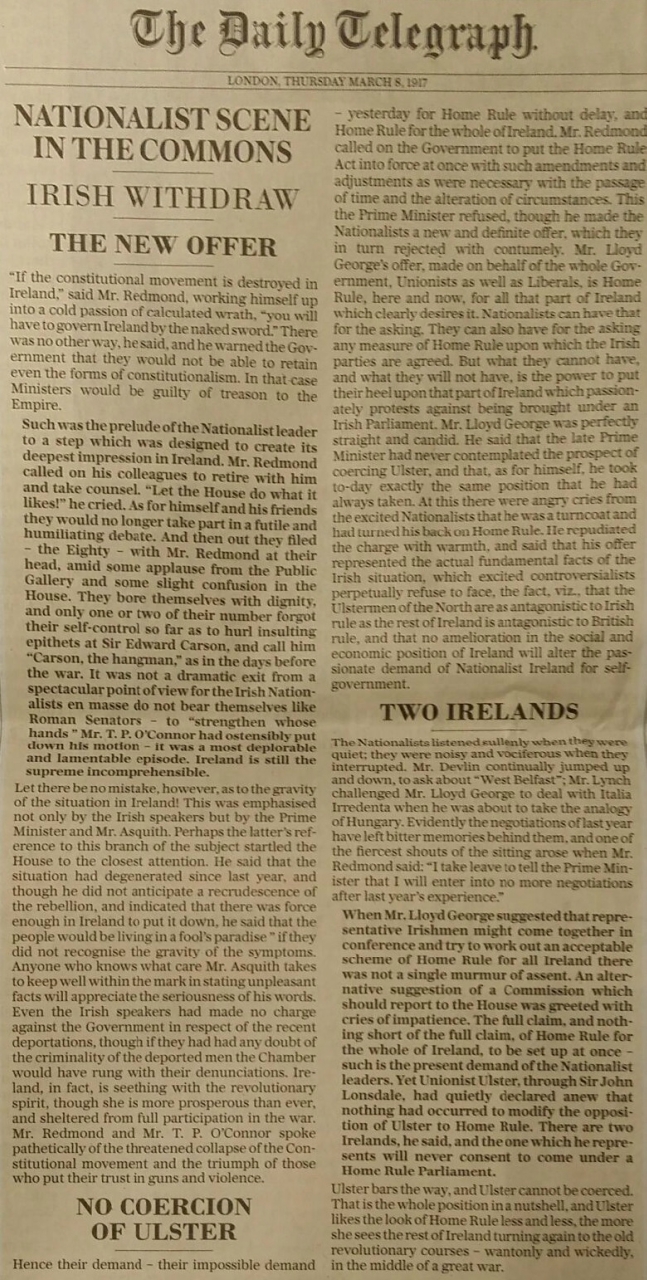
ireland.jpg


http://www.thetimes.co.uk/past-six-days/2017-03-03/register/a-despicable-offence-dg862k37b


A despicable offence


Four out of the five defendants in the “White City” case have been convicted and sentenced to imprisonment. They are remarkably fortunate, in our opinion, to have escaped with the penalties imposed upon them. There are countries, as the Judge told them, where they might have been shot.
The crime of which they have been found guilty is technically conspiracy to defeat the Military Service Act and another statute, but, in substance, it is conspiracy to weaken our Armies for the sake of pecuniary gain. It is treachery to the national cause, and treachery which is both dangerous and base.
Three of these men were in the service of the Crown, two are doctors, and all are possessed of some education. Yet, at a time when every available man is needed in the trenches, they conspired together for money to keep those who bribed them away from service. A more heinous offence against the State, short of actual treason, it is hard to imagine. It seems to us to be infinitely more disgraceful than desertion or than cowardice in the face of the enemy.
Weakness, irresolution, temperament tempt men to these crimes. The penalty is exacted, and it is death. But while the men in the ranks may be summarily tried and shot for them, persons at home whose one object is to make a little money out of the war, and who do not shrink from corruption and from fraud in order to make it, have nothing worse to fear than ordinary civilian offenders. The fact that some of them do not seem conscious of the enormity of their offence aggravates its mischief.
We may hope that the particular fraud disclosed in the “White City” case is exceptional, but there is plenty of evidence that callous indifference to the public good and sordid covetousness of class, or personal gain still exist side by side with the keen and generous patriotism which the war has generally evoked.
Consciences which are torpid in regard to the duties owed the nation ought to be stimulated. The sentences on the “White City” conspirators may help to quicken them, but the only force which will keep them awakened is the stern and unhesitating reprobation of public opinion.