Showing posts with label Болгарія. Show all posts

Tuesday, 2 October 2018

100 Years Ago

https://www.thetimes.co.uk/edition/register/fighting-in-a-tunnel-nls2n9grs

Fighting in a tunnel

The Germans have been beaten from their great defence, the Hindenburg Line, on which their newspapers, their generals, and their public men have assured them they could place trust, and are retiring eastwards. The heavy blow delivered by Americans and Australians on September 29, at its point of greatest strength between Bellicourt and Bony, with the deeper blow magnificently delivered by English troops to the south, staggered the Germans holding this vital point.
The German Staff hastily rushed in every division available in order to stop the gap. The 121st, 54th, and l85th Divisions and the 75th Reserve Division were in the Hindenburg line opposite the American divisions, which made their great assault on Sunday. That day’s fighting shattered and disorganized them to such an extent that they rushed up three divisions into the line at the same point. These were the 2nd Guard Division and the 21st Division, which already smashed by Australian attacks had only been resting a fortnight, and the 119th Division.
But the Germans knew the Hindenburg line was already lost. All yesterday troops and transport were withdrawing along the roads leading east. The Australians and Americans managed yesterday to reach the village of Bony, which for two days held up the advance, and today Australian patrols are well beyond it, and nearing the northern entrance of the great tunnel of which they already hold the southern end.
This morning the Germans still hold the northern end of the great canal tunnel while we hold the south. The barges on which the German troops lived still lie inside the tunnel, and beside the towpath inside the entrance. The entrance to the tunnel is 80ft below the hill surface. Somewhere in that black interior lies the point where the Australian possession of the towpath ends and the German begins, but probably neither Australian nor German knows where that point is. Possibly by now our troops are through, but the fighting yesterday was always stiff in the labyrinth of surface trenches.
The country reached by our troops is now green and less broken by shell fire. The shell-shattered band where British and German Armies faced one another along the Hindenburg line last winter is now passed.

Tuesday, 25 September 2018

This Week in History - Nicopolis (22-28 September 1396

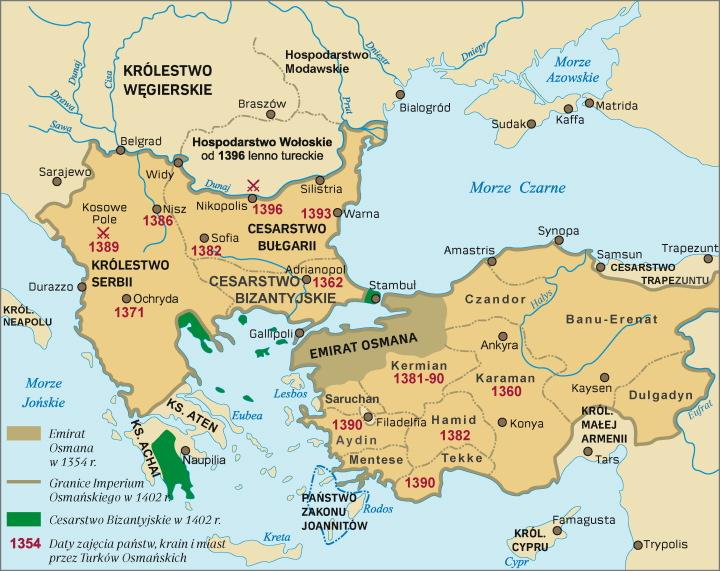
The battle of Nicopolis was the end of the crusades, but also the first encounter between the Ottoman Turks and the soldiers of western Europe. During the second half of the 14th century, the rapid spread of Ottoman Turkish conquests, and particularly the Ottoman threat to Hungary, was causing great consternation in western Europe. Further provocation was provided by the siege of Constantinople, the last remnant of the Byzantine Empire, in 1391 by Sultan Bãyazîd I 'The Lightning'. Pope Boniface IX preached a crusade and soon an army of English, French, Germans, Italians and Knights Hospitallers under the leadership of John of Nevers, son of Philip the Bold, Duke of Burgundy marched east towards Constantinople, joining a Hungarian army under King Sigismund of Hungary on the way. They advanced deep into new Turkish territory, but were halted at the town of Nicopolis, which resisted the Crusader siege for over two weeks.

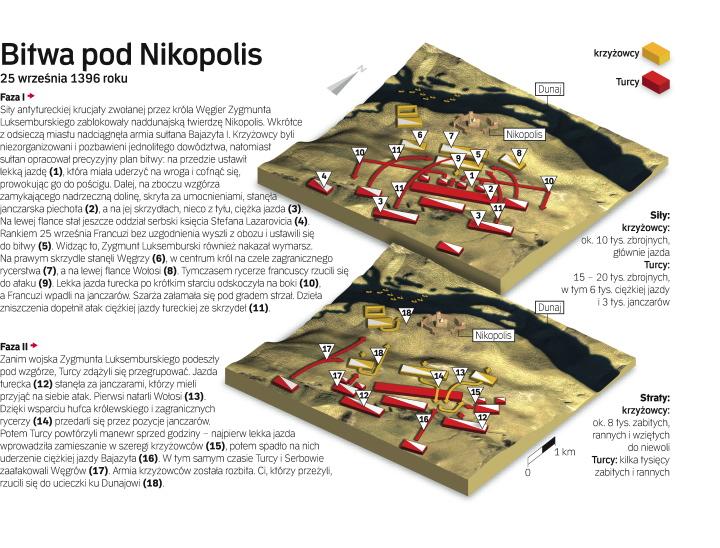
Sultan Bãyazîd decided to march to the town's rescue. He chose a defensive position straddling the road to the city with his flanks protected by ravines. Sigismund advised a cautious approach, but the western crusaders would have none of that. Instead, they charged straight at the Ottomans.
After a fierce battle, the Ottomans were victorious. It was a devastating loss for the Crusaders, particularly as Bãyazîd, enraged by his heavy losses, slaughtered most of his prisoners the next day.


Thursday, 6 September 2018

The Times History of the War - First rent in the German alliance: surrender of Bulgaria

First rent in the German alliance: surrender of Bulgaria
This week's chapter examines the fall of Monastir (Nov 1916) followed by quiet period on Salonika front, General Milne's winter problems, offensive in Doiran sector, April 1917, Koritza, Allied success in Albania, the coup d'etat of Athens June 1917, triumph of Venizelos and the policy of Greek mobilization in Allied interest, internal situation in Bulgaria, zenith and anticlimax of pro-German solidarity, prospects of summer 1918 campaign, survey of British front, Hellenic reinforcements, combined advance of September, the great days of September 14-28, armistice of September 29, 1918, percussion throughout the world, omens not to be disguised, vanished dream of Bulgar hegemony in South-Eastern Europe
At eight o'clock on the morning of September 26, a Bulgarian parlementaire, under a white flag and bearing a proposal to conclude an armistice, approached the British lines, and was immediately conducted to Sir G Milne's Headquarters and thence to the Allied Headquarters at Salonika

Thursday, 21 September 2017

This Week in History - Nicopolis (22-28 September)

https://ospreypublishing.com/thisweekhistory/


The battle of Nicopolis was the end of the crusades, but also the first encounter between the Ottoman Turks and the soldiers of western Europe. During the second half of the 14th century, the rapid spread of Ottoman Turkish conquests, and particularly the Ottoman threat to Hungary, was causing great consternation in western Europe. Further provocation was provided by the siege of Constantinople, the last remnant of the Byzantine Empire, in 1391 by Sultan Bãyazîd I 'The Lightning'. Pope Boniface IX preached a crusade and soon an army of English, French, Germans, Italians and Knights Hospitallers under the leadership of John of Nevers, son of Philip the Bold, Duke of Burgundy marched east towards Constantinople, joining a Hungarian army under King Sigismund of Hungary on the way. They advanced deep into new Turkish territory, but were halted at the town of Nicopolis, which resisted the Crusader siege for over two weeks.


Sultan Bãyazîd decided to march to the town's rescue. He chose a defensive position straddling the road to the city with his flanks protected by ravines. Sigismund advised a cautious approach, but the western crusaders would have none of that. Instead, they charged straight at the Ottomans. After a fierce battle, the Ottomans were victorious. It was a devastating loss for the Crusaders, particularly as Bãyazîd, enraged by his heavy losses, slaughtered most of his prisoners the next day.

Further reading

For the full story of the last crusade, Campaign 64: Nicopolis 1396 The last Crusade (extract below) is a detailed account. Campaign 132: The First Crusade 1096-99 Conquest of the Holy Land is a new book giving the account of the very first crusade, three hundred years previously. To set Nicopolis against its background of three centuries of crusading, Essential Histories 1: The Crusades gives an overview of the entire period, and discusses the causes, context and consequences of the Crusades. For the Ottoman perspective of Nicopolis, turn to Essential Histories 62: The Ottoman Empire 1326-1699. Finally, for more information about Hungary in the last Crusade, and the subsequent fortune of Eastern Europe, Men-at-Arms 195: Hungary and the fall of Eastern Europe 1000-1568 is a detailed study.

Men-at-Arms 75: Armies of the Crusades, Elite 19: The Crusades, Men-at-Arms 155: Knights of Christ, and Men-at-Arms 125: The Armies of Islam 7th-11th Centuries cover the various armies involved in the crusading period. For information about the specific armies at Nicopolis, turn to Warrior 41: Knight Hospitaller (2) 1306-1565, Men-at-Arms 144: Armies of Medieval Burgundy 1364-1477 and Men-at-Arms 140: Armies of the Ottoman Turks 1300-1774.