|
The Navy's work completed
|
 |
|
This chapter contains
a survey of the sea war, Germany's false reckoning, loss of her oversea
squadrons and colonies, adoption of submarine war on commerce, North Sea
episodes, Jutland, a decisive victory, allied navies in the Adriatic, naval
and military cooperation, the navies' share in the enemies' collapse,
internment of the hostile fleets, historic surrender of the German Navy in
the North Sea, November 21, 1918, scuttling of the German ships at Scapa,
King George's tribute to his fleet
|
|
"Ever since that fateful Fourth of August, 1914, I have
remained steadfast in my confidence that, whether fortune frowned or smiled,
the Royal Navy would once more prove the sure shield of the British Empire in
the hour of trial. Never in its history has the Royal Navy, with God's help,
done greater things for us, nor better sustained its old glories and the
chivalry of the seas." George V
|
Monday, 8 October 2018
The Times History of the War - The Navy's work completed


Tuesday, 2 October 2018
100 Years Ago
https://www.thetimes.co.uk/edition/register/fighting-in-a-tunnel-nls2n9grs
OCTOBER 2, 1918
Fighting in a tunnel
The Germans have been beaten from their great defence, the Hindenburg Line, on which their newspapers, their generals, and their public men have assured them they could place trust, and are retiring eastwards. The heavy blow delivered by Americans and Australians on September 29, at its point of greatest strength between Bellicourt and Bony, with the deeper blow magnificently delivered by English troops to the south, staggered the Germans holding this vital point.
The German Staff hastily rushed in every division available in order to stop the gap. The 121st, 54th, and l85th Divisions and the 75th Reserve Division were in the Hindenburg line opposite the American divisions, which made their great assault on Sunday. That day’s fighting shattered and disorganized them to such an extent that they rushed up three divisions into the line at the same point. These were the 2nd Guard Division and the 21st Division, which already smashed by Australian attacks had only been resting a fortnight, and the 119th Division.
But the Germans knew the Hindenburg line was already lost. All yesterday troops and transport were withdrawing along the roads leading east. The Australians and Americans managed yesterday to reach the village of Bony, which for two days held up the advance, and today Australian patrols are well beyond it, and nearing the northern entrance of the great tunnel of which they already hold the southern end.
This morning the Germans still hold the northern end of the great canal tunnel while we hold the south. The barges on which the German troops lived still lie inside the tunnel, and beside the towpath inside the entrance. The entrance to the tunnel is 80ft below the hill surface. Somewhere in that black interior lies the point where the Australian possession of the towpath ends and the German begins, but probably neither Australian nor German knows where that point is. Possibly by now our troops are through, but the fighting yesterday was always stiff in the labyrinth of surface trenches.
The country reached by our troops is now green and less broken by shell fire. The shell-shattered band where British and German Armies faced one another along the Hindenburg line last winter is now passed.
The Times History of the War - The Allied advance continued, October 1918
|
The Allied advance continued,
October 1918
|
 |
|
This week's chapter
examines the position at the beginning of OCtober 1918, the
Beaurevoir-Fonsomme line attacked, October 3, American progress in the
Argonne, Gouraud's success at Moronvillers, Reims freed, great British attack
of October 8 between Cambrai and St Quentin, the fall of Cambrai, Germans
evacuate the St Gobain Salient, German stand on the Selle, Le Cateau stormed,
the enemy defeated in Champagne, La Fere and Laon taken, Americans reach
Grand Pre, Allied offensive in Flanders under King Albert, Roulers taken, the
Lys crossed, war in the air
|
|
The enemy's discipline was fast deteriorating, as had been
revealed by an intercepted order from the Kaiser's Adjutant General to the
German Army: "His Majesty the Kaiser," it ran, "is displeased
to note that when he is passing through villages, along roads, by a railway
crossing, and so forth, the troops fail to pay him the necessary respect, and
the inhabitants fail to greet him in the proper way by removing their
headgear. This must be seen to."
|
|
The right
answer to Germany
|
 |
|
Let it never be said
again that the British Army is admirable only in defence and has not the
spirit of attack
|
|
The news from France is the best of all answers to the German Note. Both on the western and on the eastern battle-fronts the Allied attacks were renewed yesterday morning. On the western front the attack covered the space of nearly twenty miles between Cambrai and St Quentin, and made a further progress of between two and three miles - greater in the centre than on the flanks - on a part of the enemy’s line where his defences had already been ruptured. The centre of our advance is now approaching Le Cateau, the scene of General Smith Dorriens severe, and perhaps unnecessary, engagement on the third day of the retreat from Mons. French, American, and British troops all took part in this new advance. On the east the French and Americans attacked down the right bank of the Meuse, and, though details are still lacking, made good progress towards the north. In addition, General Gouraud, continuing his advance in Champagne, crossed the Arnes and turned the enemy’s positions along the Suippe River from the eastern end. One cannot but marvel at the energy of these repeated attacks and the magnificent scope of the strategic plan that they unfold. And one may be pardoned for expressing especial admiration for the vigour and endurance of our own Army, which has been engaged in practically continuous fighting on this Western front ever since the opening of the Somme offensive in July, 1916. Except for the retreat in the spring of this year, the whole of this fighting has been in the attack. Let it never be said again that the British Army is admirable only in defence and has not the spirit of attack. On the contrary, though the record of the French Army is in some respects even more wonderful, there is no Army - not even the German - that has achieved so long and so sustained an offensive. For an Army that really did not exist on a Continental scale until the year before last this is an achievement that is still not appreciated here at its full value. It is not altogether out of French politeness that our Allies rute it higher than we sometimes seem to do.
|
But even more remarkable than the duration of the offensive is the strategic splendour of its plan. Nothing that the Germans did even in their first campaign in France or on the Russian front later can approach it. The metaphor of the pincers is familiar and intelligible, but never was there anything in war to compare with the strategic mechanism, elaborate but never complicated, of Marshal Foch’s pincers. You have enveloping movements one within the other. Inside you have the envelopment of the German centre in progress in the combined operations north of St Quentin on the one hand and on the Chemin des Dames on the other. Then you have on the western arm of the pincers the enveloping movement against Lille, and on the eastern arm the combined movements of French and Americans in Champagne and the Argonne against Vouziers and the Defile of Grand Pre. Lastly, still farther out, you have the great enveloping movements, still rudimentary, out from Ypres and down the Meuse. The bigness of the design is now apparent. How big it is may be gathered from the reflection that the great offensives reported today - the movements that threaten the German centre in the Laon-Le Fere hills, and the movement in that eastern section north of Verdun which perhaps promises the most decisive results of all - are only three out of many cogwheels in this vast machinery of constriction.
These renewed attacks, then, are our reply to the German request for an armistice, and a reply that expresses the sentiment of armies and civilians alike. But, however successful our attacks, they cannot in one respect be a complete answer to the German peace offensive. The enemy’s retreat will be through the country of our Allies, and if we may judge by what has happened at Douai, at Lens, and at Laon, hie means to go out with arson as he came in with assault and battery. Even that does not quite plumb the depravity of the enemy’s conduct, for he has made this policy of unmilitary destruction and devastation a part of his peace propaganda - as who should say, Give me the advantages of a truce, or I will burn and destroy everything in my retreat. It is a species of blackmail, both cruel and mean. Now, no military success can quite combat the enemy’s power if he wishes to commit outrage of this kind; and (unless indeed we were able to prevent the enemy from retreating at all, and to accomplish some comprehensive Sedan in the heart of’ the territories that he at present occupies) we are faced with the prospect of marching to victory over the blackened ruin of all that civilization has achieved in beauty or utility.
For special crimes special punishments have to be devised. This barbarous destruction must be made demonstrably unprofitable, and that in a currency of punishment that even the coarsest minds cannot fail to understand. If the enemy destroys cities in France and Belgium, then cities in Germany must suffer the penalty. Eye for an eye, tooth for tooth, town for town.
The Allies must protect themselves from the purely wanton forms of wickedness. General threats of reprisals do not seem to us to meet the situation. They should be specific in their nature, and should be relentlessly carried out should the enemy’s malpractices continue after notice has been given. If Bruges is destroyed, either by the enemy’s arson or as the result of a hopeless defence, then Hamburg must pay; if Lille, then Frankfurt. The payment need not necessarily take the same form as the crime, but the Germans quite understand the practice of taking hostages for good behaviour. German towns must be marked down for ransom for French and Belgian towns destroyed apart from military necessity.
The Times History of the War - The Conquest of Syria
|
The Conquest of Syria
|
 |
|
This week's chapter
examines the Turks expelled from Arabic vilayets, opposing forces in
Palestine, Allenby's strategy, the battles of Sharon and Mount Ephraim, the
great cavalry ride, Von Liman's narrow escape, work of the Air Force, two
Turkish armies destroyed, the East Jordan operations, from Galilee to
Damascus, Syrian seaports seized, Homs occupied, the advance to Aleppo, tasks
of political department, Marshall's victory on the Tigris, two years at Aden,
the surrender of Medina
|
|
The Germans had fired great dumps of ammunition, petrol, and
the hangars and workshops on the aerodromes at our approach. But one plane
was seized intact, and close by was found a big cave containing thousands of
bottles of champagne and other wines and spirits
|
|
How
Nazareth was captured
|
 |
|
The cavalry of General
Allenby's Army swam and forded the Jordan north of Lake Tiberias last night
|
|
Yesterday I spent a couple of hours at Nazareth with the West Country Yeomanry who first entered the town. The capture of the place was highly dramatic. The Yeomanry crossed Esdraelon Plain in the dark, having covered fully 60 miles from the Jaffa district within 24 hours. Trotting up the steep, tortuous roadway to Nazareth just before the dawn they overran a moving convoy of 75 motor-lorries. The German drivers were greatly startled at the apparently miraculous appearance of our horsemen, and in the confusion which followed a number of the lorries were overturned off the narrow mountain road. Maintaining their place, the Yeomanry clattered over the crest into the little hilltop basin where Nazareth lies.
|
The town contained numerous enemy troops. These, like the inhabitants, were still sleeping, believing the line unbroken and our Army many miles away. The Yeomanry quickly made the whole force prisoners. The British, however, were only a small party, and when later in the day the German machine-gunners from the ridges round the town to the north opened a vigorous fire, they temporarily withdrew.
The following morning they outflanked the machine-gun posts and re-entered Nazareth. That night the Turks counter-attacked, but meanwhile our force was strengthened by some Indian Lancers galloping out, who killed 50 and took 100 prisoners in a slashing moonlight charge. The inhabitants expressed the greatest delight at the arrival of the British.
Returning from Nazareth I came across an armoured motor battery and light car patrol proceeding on a flying reconnaissance to Haifa and joined the enterprise. The little expedition was marked by splendid dash and daring. Speeding over the hills of Lower Galilee, we crossed the Esdraelon Plain and then ran east under the shadow of Mount Carmel. When we were many miles in advance of our outposts and three miles from Haifa we encountered an enemy post, and after a brief engagement we captured 70 prisoners, including two officers.
Over the next two miles our prisoners increased to upwards of 100. Armoured cars pushed impudently into the outskirts of the town. Despite the heavy fire from enemy batteries and machine-guns and rifle fire at point:blank range, the mission was fully accomplished. The cars pulled out slowly, marching the prisoners before them,. all the while fighting a vigorous rearguard action.
The remarkable success of Allenby’s bold strategy is largely due to the complete ascendancy of British airmen. Towards this the Australian squadron very substantially contributed. For a fortnight preceding the advance the enemy was kept practically blind. Scarcely a single German machine crossed our line, and any machine which came was immediately challenged and destroyed or chased right home to his aerodrome. Simultaneously all enemy aerodromes were being bombed, as we now know from personal observation, almost out of existence. The Australian part in this work is demonstrated by the fact that 12 Distinguished Flying Crosses were awarded to our men in six weeks.
TURKS FIGHT TO SAVE DAMASCUS
The cavalry of General Allenby’s Army swam and forded the Jordan north of Lake Tiberias last night, and today captured the high ground east thereof. The situation is developing most favourably.
The mounted troops hold a far-flung line, the horsemen converging in two great columns on the main Damascus roads. From the south Yeomanry and Indian cavalry moving eastwards. from Beisan have taken Irbid, where a portion of the Turkish Fourth Army not destroyed at Amman intended to stand. The important railway junction of Deraa having been secured, the Arabs on our east, ignoring the bodies of the enemy between Deraa and Amman, marched north on Sheikh Miskin, which is within one cavalry bound of Damascus.
In going forward the cavalry several times left enemy parties in their rear in order to reap the full results of their bold strategy, the advancing infantry clearing. the enemy out of isolated places, as, for instance, in the Yarmuk Valley, where Germans and Turks were holding positions on the railway after Deraa had been taken. The infantry dealt with them and prevented the destruction of some useful railway works.
The Turks, in fear of designs on Damascus, sent down to the Jordan from that city a force composed of Germans, Turks, and some Circassians. When our cavalry were opposite the bridge at Benat Yakub, motor lorries from Damascus had deposited a thousand men on the steep eastern bank of the Jordan, covering the bridge with machine-guns.They blew up the centre arch of the 400-year-old bridge, making a crossing there impossible. A brigade of Australian Light Horse swam the river with the horses farther south, another Australian brigade making a passage of the river to the north. The ground approaching the river was marshy, but so swiftly were the difficulties surmounted that before the enemy could scramble back to their lorries 200 Turks, 50 German, three field guns, and some machine guns were cut off and captured.
At 6 this morning the cavalry were at Dar Ezaras, astride the Damascus road, and have since advanced to El Kuneitra, within 40 miles of the ancient city. It is an interesting race between the two columns as to which will reach the coveted point first. One cannot move a mile in this rough, desolate hill country without marvelling at the endurance of the troops.
Tuesday, 25 September 2018
This Week in History - Nicopolis (22-28 September 1396
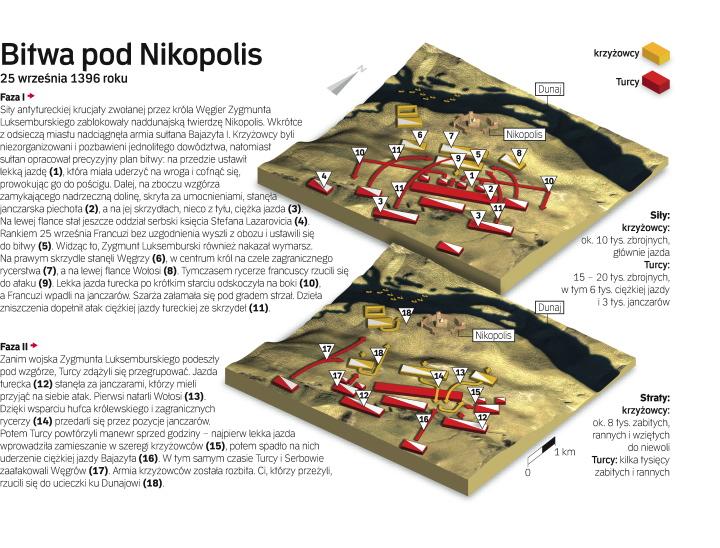
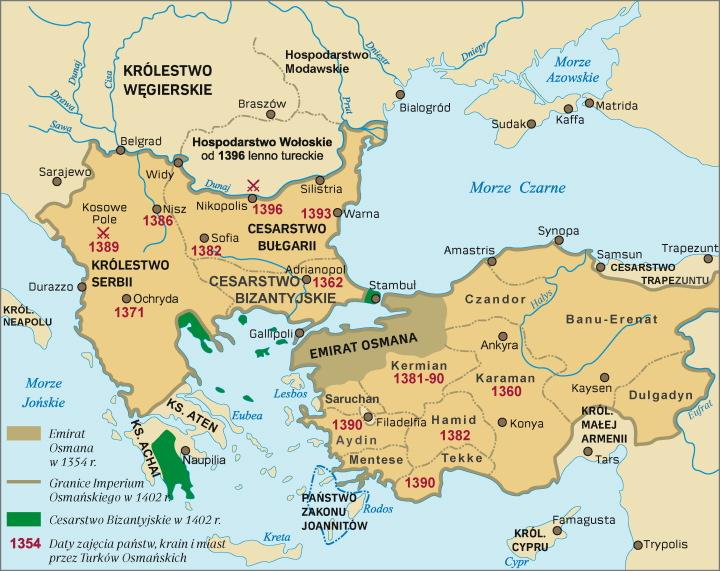
The battle of Nicopolis was the end of the crusades, but also the first encounter between the Ottoman Turks and the soldiers of western Europe. During the second half of the 14th century, the rapid spread of Ottoman Turkish conquests, and particularly the Ottoman threat to Hungary, was causing great consternation in western Europe. Further provocation was provided by the siege of Constantinople, the last remnant of the Byzantine Empire, in 1391 by Sultan Bãyazîd I 'The Lightning'. Pope Boniface IX preached a crusade and soon an army of English, French, Germans, Italians and Knights Hospitallers under the leadership of John of Nevers, son of Philip the Bold, Duke of Burgundy marched east towards Constantinople, joining a Hungarian army under King Sigismund of Hungary on the way. They advanced deep into new Turkish territory, but were halted at the town of Nicopolis, which resisted the Crusader siege for over two weeks.
Sultan Bãyazîd decided to march to the town's rescue. He chose a defensive position straddling the road to the city with his flanks protected by ravines. Sigismund advised a cautious approach, but the western crusaders would have none of that. Instead, they charged straight at the Ottomans.
After a fierce battle, the Ottomans were victorious. It was a devastating loss for the Crusaders, particularly as Bãyazîd, enraged by his heavy losses, slaughtered most of his prisoners the next day.


Sultan Bãyazîd decided to march to the town's rescue. He chose a defensive position straddling the road to the city with his flanks protected by ravines. Sigismund advised a cautious approach, but the western crusaders would have none of that. Instead, they charged straight at the Ottomans.
After a fierce battle, the Ottomans were victorious. It was a devastating loss for the Crusaders, particularly as Bãyazîd, enraged by his heavy losses, slaughtered most of his prisoners the next day.
Friday, 14 September 2018
100 Years Ago
 SEPTEMBER 14, 1918
America’s first great blow
The United States First Army, under General Pershing, has obliterated in a day and a half the St Mihiel salient, which for four years has been thrust like a poisoned dagger into the French front. The blow was neat, quick, and complete. The American troops clipped off the salient with a single movement.
We rejoice that the first great enterprise undertaken by the United States forces on the Western front has had such swift and dramatic results. General von Ludendorff is audacious enough to declare that the evacuation of the salient “had been under consideration for years”, and that “was commenced a few days ago”. The obvious answer is that the German Higher Command must have been still in the stage of “consideration” when the American blow fell, for an early count of prisoners shows a total of 13,300. A further point is that the town of St Mihiel was very little damaged, which indicates that the enemy had no time to engage in their usual work of wanton destruction.
The American victory shortens the front by at least twenty miles, and brings the Allies five miles nearer to Metz. At Pagny they are practically touching the German frontier, which lies just across the Moselle. For the Allied nations, though, the deep interest of the American victory lies, not so much in its results, but in the fact that a great United States force has gone into battle acting separately and on its own account. The German General Staff has made many amazing blunders, but it never made a worse or more egregious error than when it believed that the United States, either from lack of ships or capacity to raise great armies, could not deliver the goods.
More was destroyed at St Mihiel than a German salient. General Pershing shattered at a blow the monstrous web of lies which has sustained the pretence that the United States would be of little or no account in the European field of war. He has shown in one brilliant day that the Americans are as quick and apt to learn the art of war as they have been to develop the pursuits of peace. Henceforward the American armies take their stand, fully arrayed, beside their war-worn Allies who have so long fought in the Old World the battle for that freedom which is the birthright of the New.
This week in history - The Battle of the Alma (15-22 September 1854) - 2

https://www.bookclub.ua/catalog/e-books/e-books-facts/product.html?id=39732
Битва на Альмі
Висадження франко-британо-турецького десанту біля Євпаторії стало повною несподіванкою для росіян. Російськими військами командував недавній імператорський посланець до Стамбула князь Меншиков, чиї дії багато в чому посприяли розв’язуванню війни.Він не виявився успішнішим у ролі полководця, ніж у ролі дипломата. Щоб заступити союзникам шлях на Севастополь, він вибрав для своєї 36-тисячної армії сильну оборонну позицію на пагорбах на правому (південному) березі невеликої річки Альма, біля її гирла. Російські позиції прикривали 96 гармат, у тому числі розміщених у двох польових укріпленнях. Меншиков вважав, що урвища біля моря, на його лівому фланзі, не дадуть союзникам можливості атакувати в цьому місці, то ж там він залишив тільки невелике прикриття. Крім того, він побоювався, що війська, розміщені біля моря, можуть бути обстріляні великим союзним флотом.
Російській армії протистояли 56 тисяч французів, британців і турків із 122 гарматами — менше на кілька тисяч від числа, висадженого в Євпаторії, бо частина вже заслабла від холери, у тому числі й маршал Сент-Арно. Праворуч, біля моря, стали французи, ліворуч — британці, за ними — турки. Через обмаль кавалерії не було можливості обійти російське військо з лівого крила союзників. Сент-Арно і Раґлан вирішили, що французи почнуть атаку першими проти, як вони думали, головних російських сил (виявилося, що є стежка, якою можна провести солдатів на «неприступні» урвища,), а за ними на своєму крилі атакують британці.
Subscribe to:
Posts (Atom)